


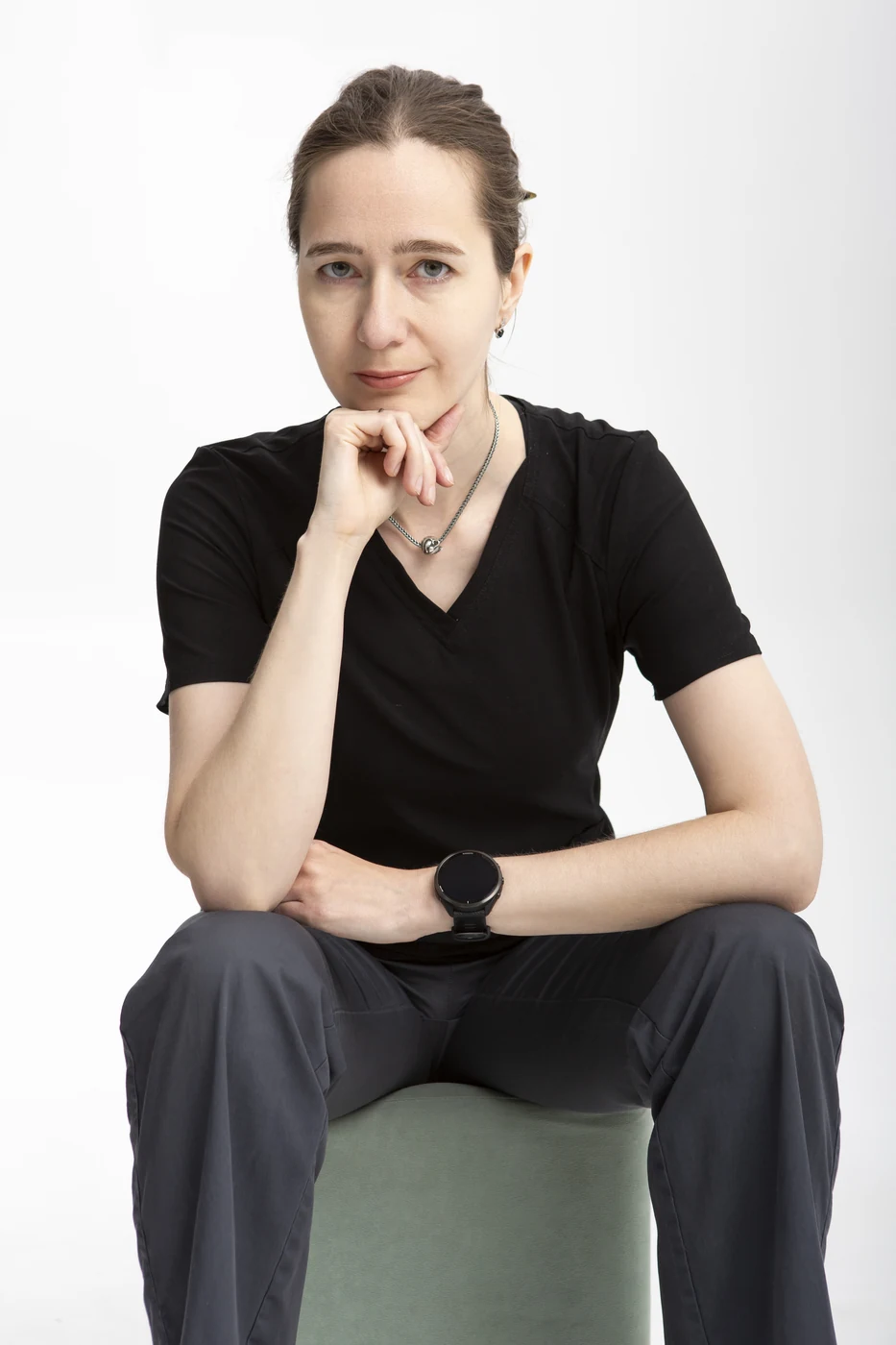
Qualifications and experience
- Osteopath and neurophysiologist.
- Graduate of the European School of Osteopathy, UK (BSc, DO, Hons.).
- Candidate of Sciences in physiology and neurobiology (Lomonosov Moscow State University), recognised as a PhD by Norway’s NOKUT.
- Graduate of A. E. Smirnov’s Osteopraktika Project school.
- Certified kinesiology taping practitioner (Bbalance).
- Foot orthotics practitioner (Formthotics).
- Participant in numerous osteopathy seminars, cadaveric anatomy seminars and other professional events.
- Aromatherapist (Tisserand Institute).
- Practising since 2015.
- Co-author, with Natalia Dazmirovna Suvorova-Bleynes, of Kinesiology Taping in Paediatrics (2022).
- Participant in Russian and international neuroscience conferences; author of over 20 scientific papers (2008–2014).
Diplomas and certificates
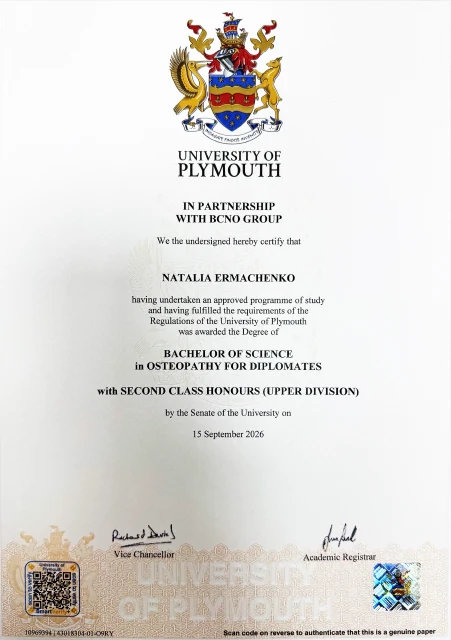 BSc with Honours, University of Plymouth
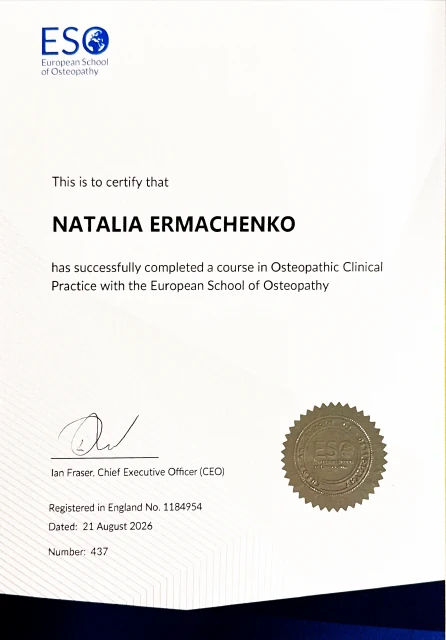 Osteopathic Clinical Practice, ESO
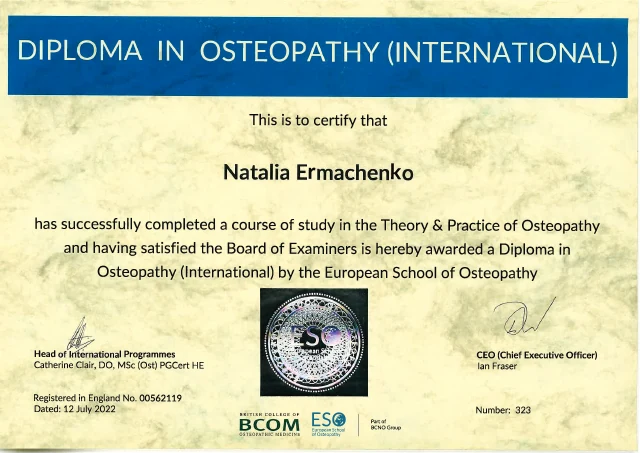 Diploma in Osteopathy, ESO
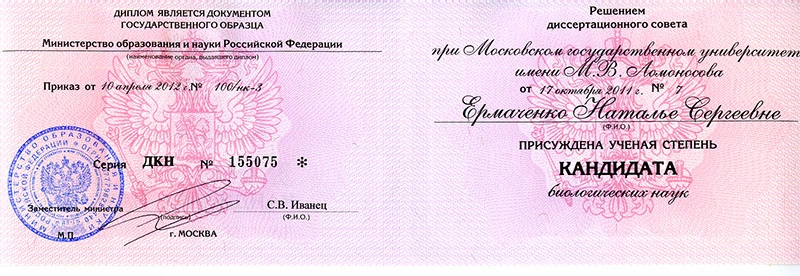 Candidate of Sciences diploma
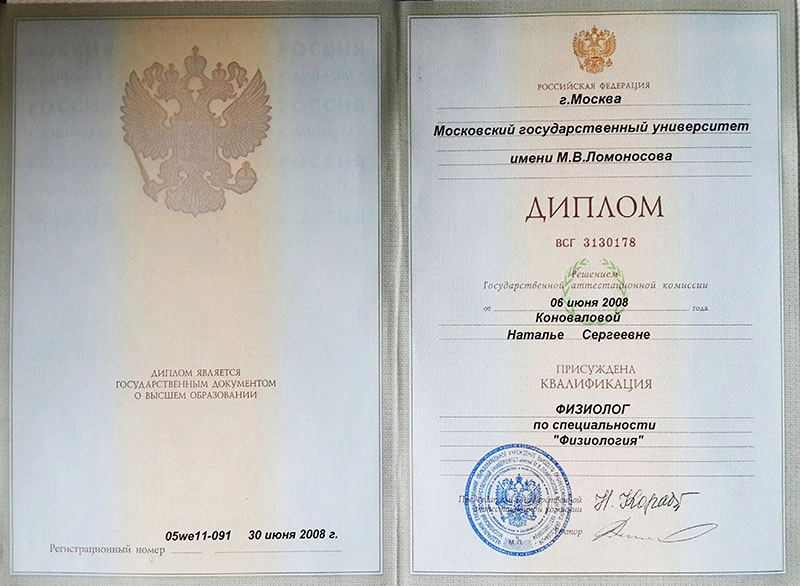 Physiology diploma, Moscow State University
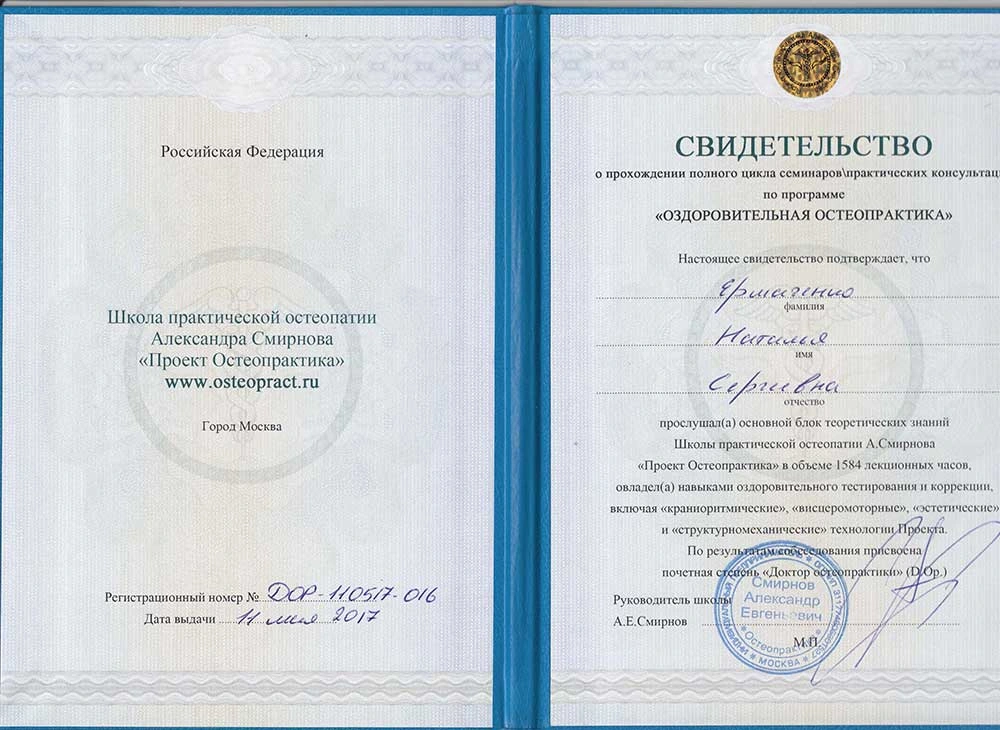 Osteopraktika Project certificate
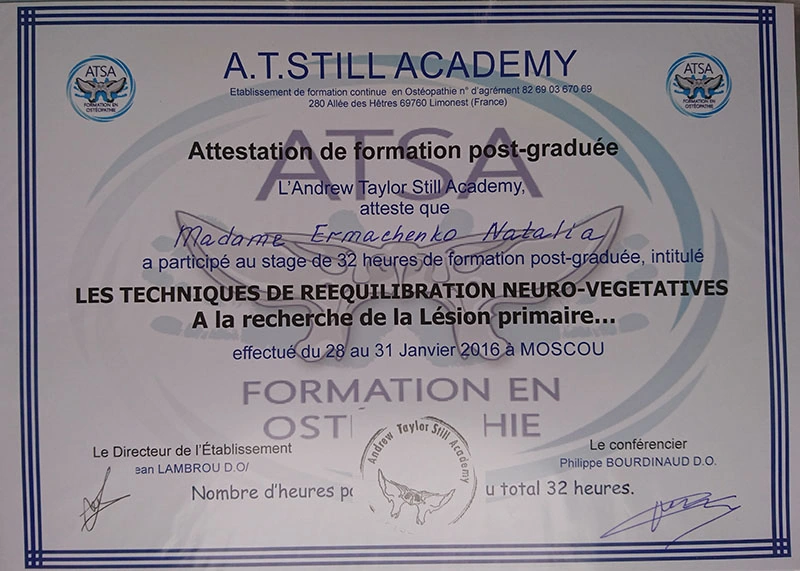 A. T. Still Academy postgraduate seminar
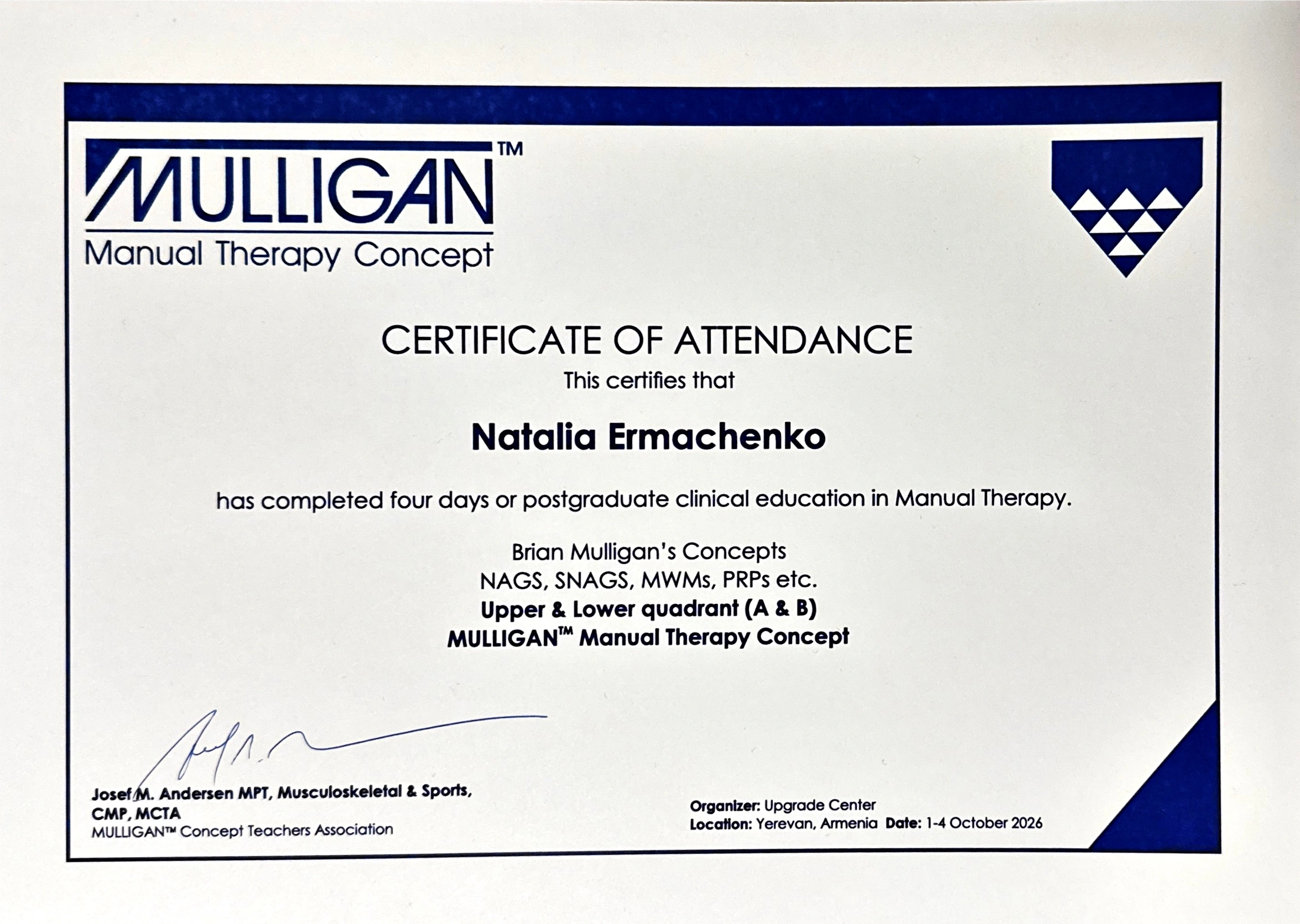 Mulligan Concept, A and B course
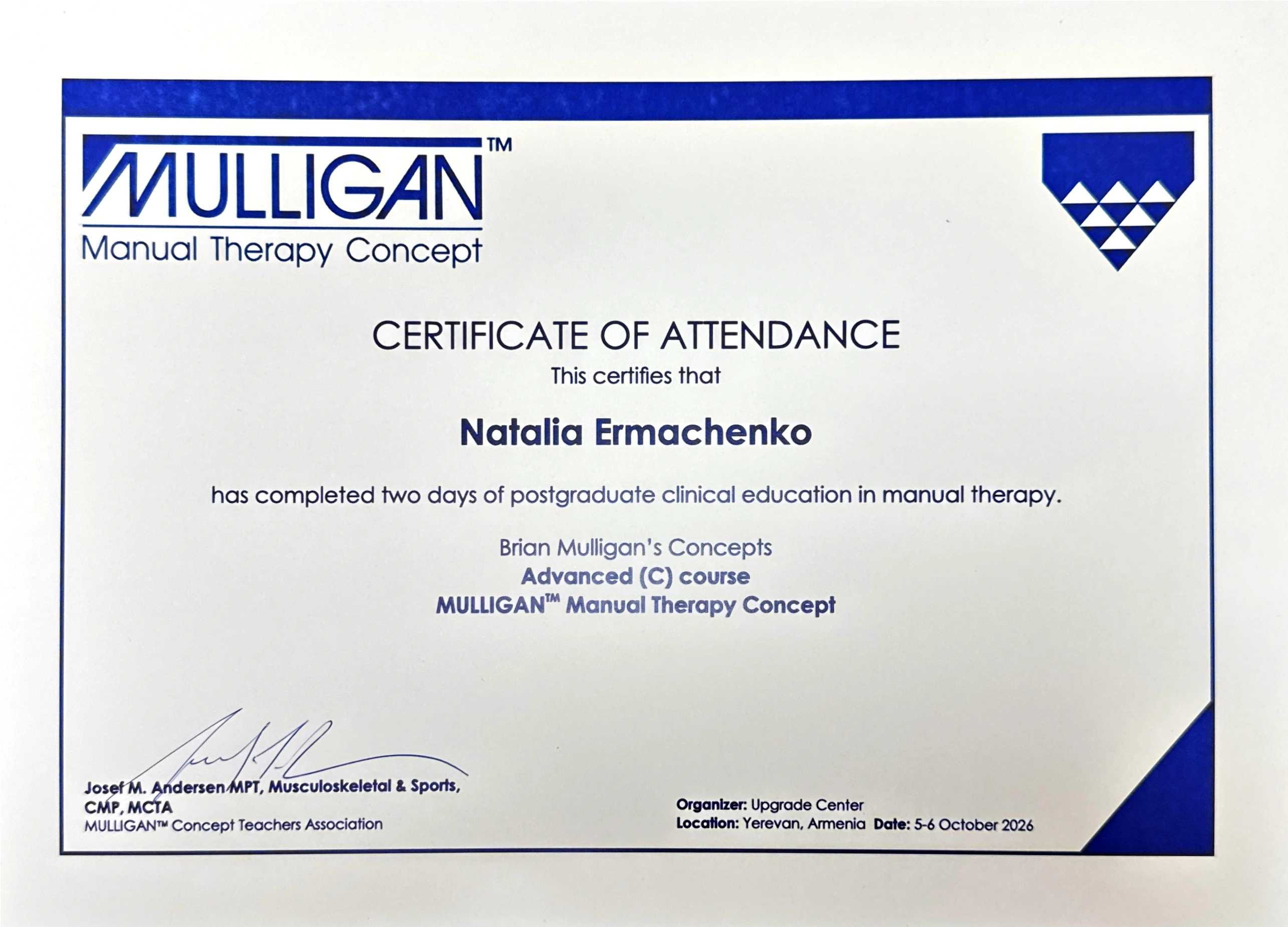 Mulligan Concept, advanced C course
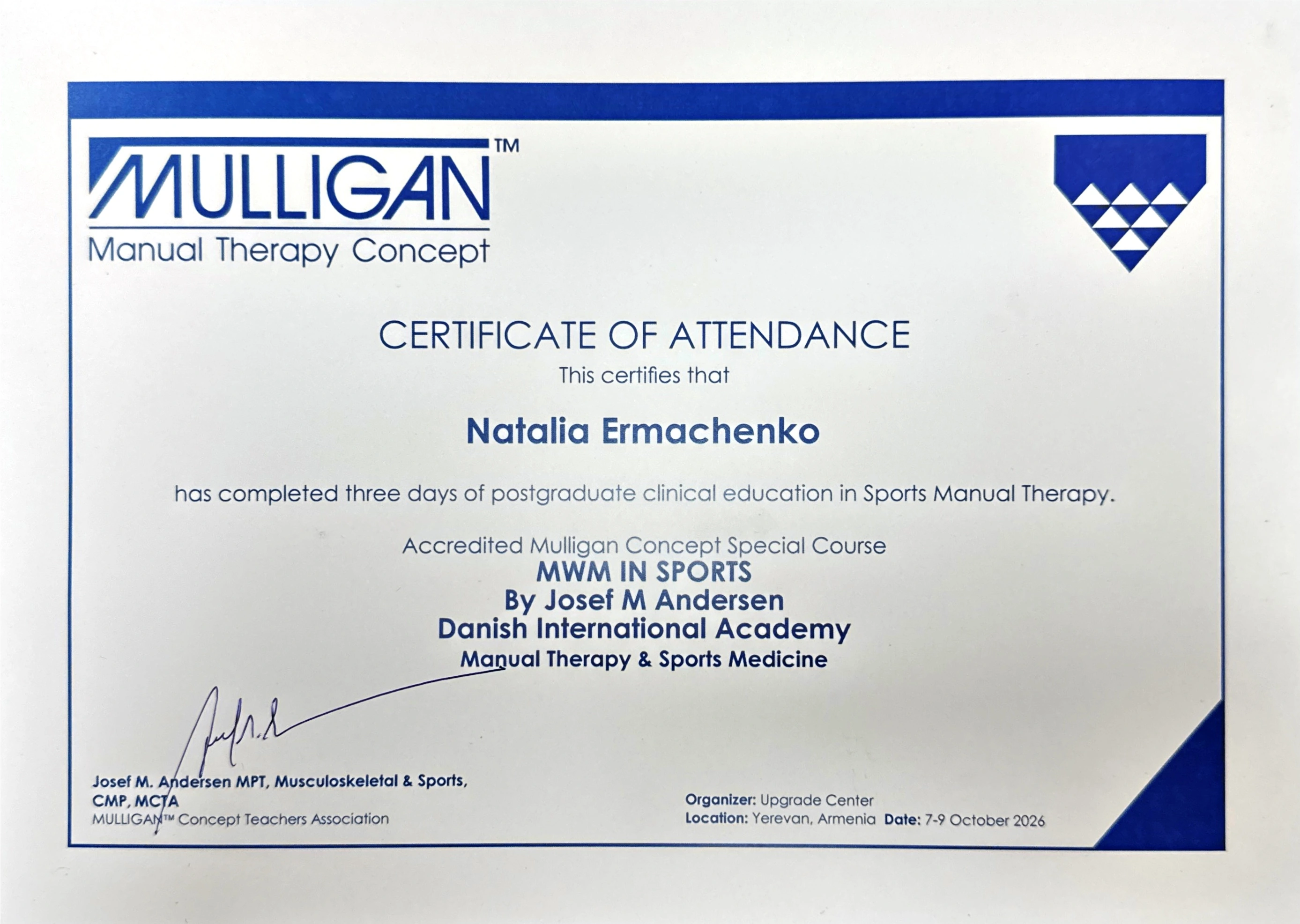 Mulligan Concept, MWM in Sports
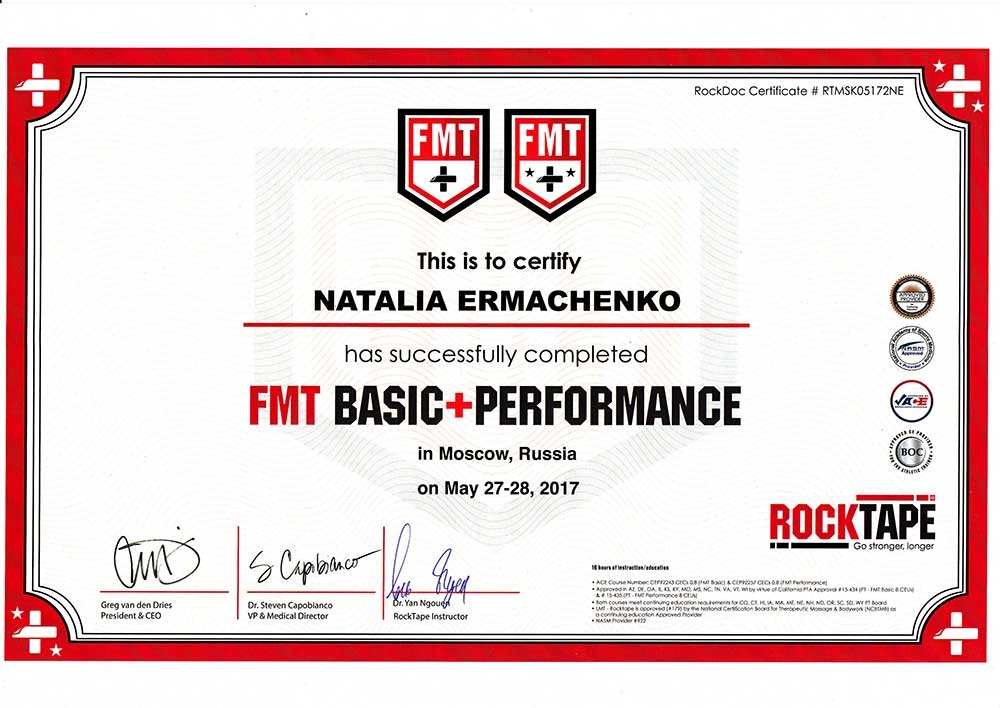 FMT Basic + Performance, RockTape
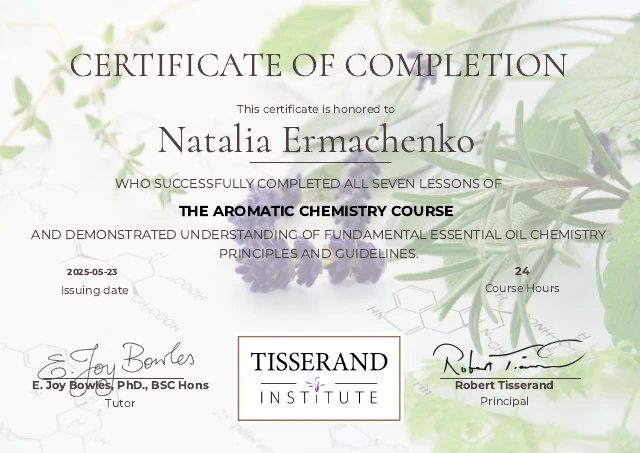 Aromatic Chemistry, Tisserand Institute
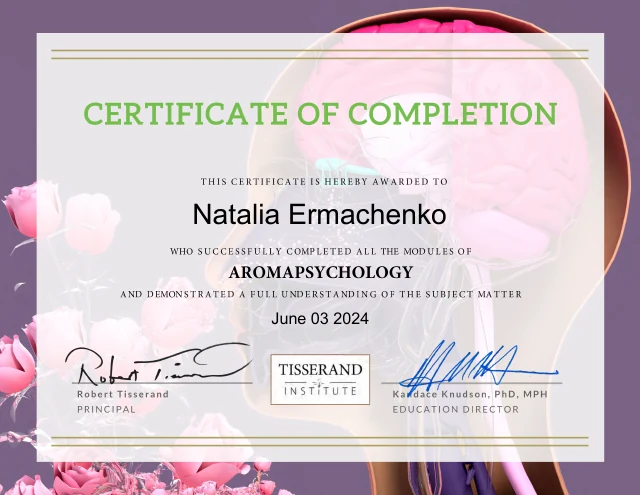 Aromapsychology, Tisserand Institute
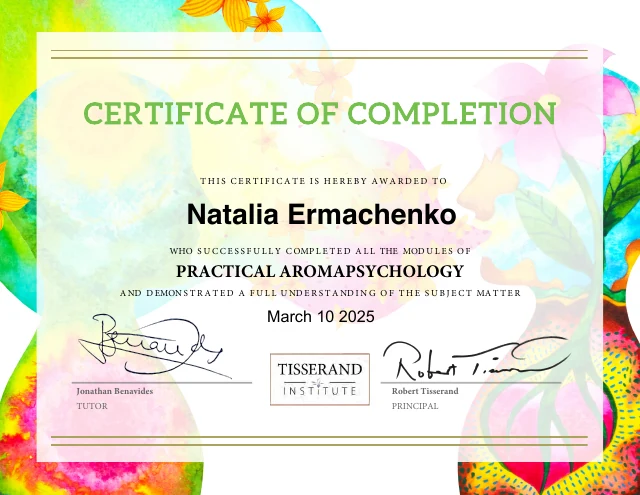 Practical Aromapsychology, Tisserand Institute
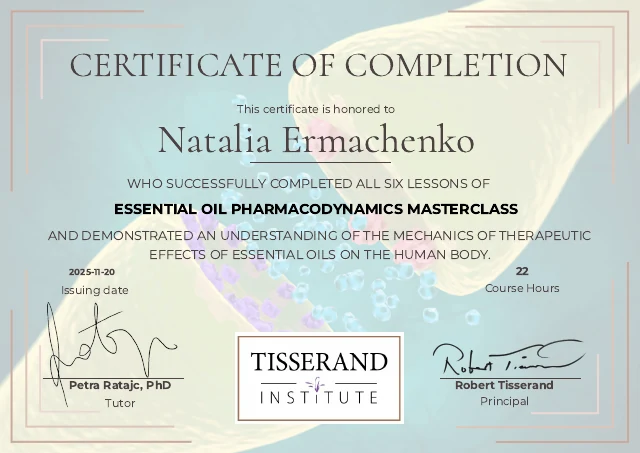 Essential Oil Pharmacodynamics, Tisserand Institute
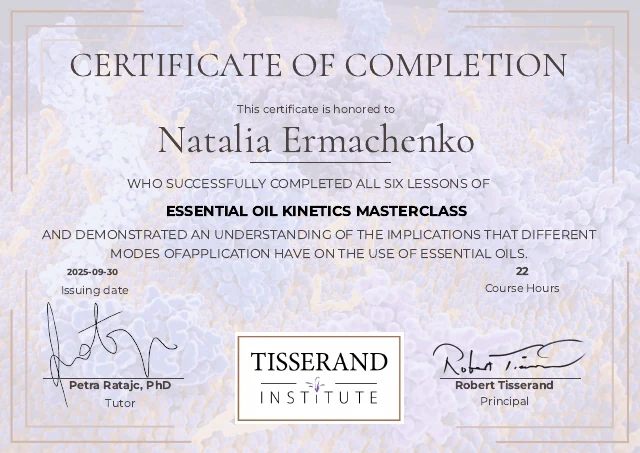 Essential Oil Kinetics, Tisserand Institute
Areas of practice
- Back, neck and joint pain.
- Headaches.
- Dizziness and tinnitus (after consulting an ENT specialist and a neurologist).
- Pain and/or clicking in the jaw joints.
- Difficulty breathing through the nose and snoring (after consulting an ENT specialist).
- Recovery after surgery, injury, childbirth and infection.
- Discomfort with no established cause, such as a lump in the throat, nausea, a feeling of food getting stuck or difficulty taking a deep breath.
- Low energy and recovery after a difficult period.
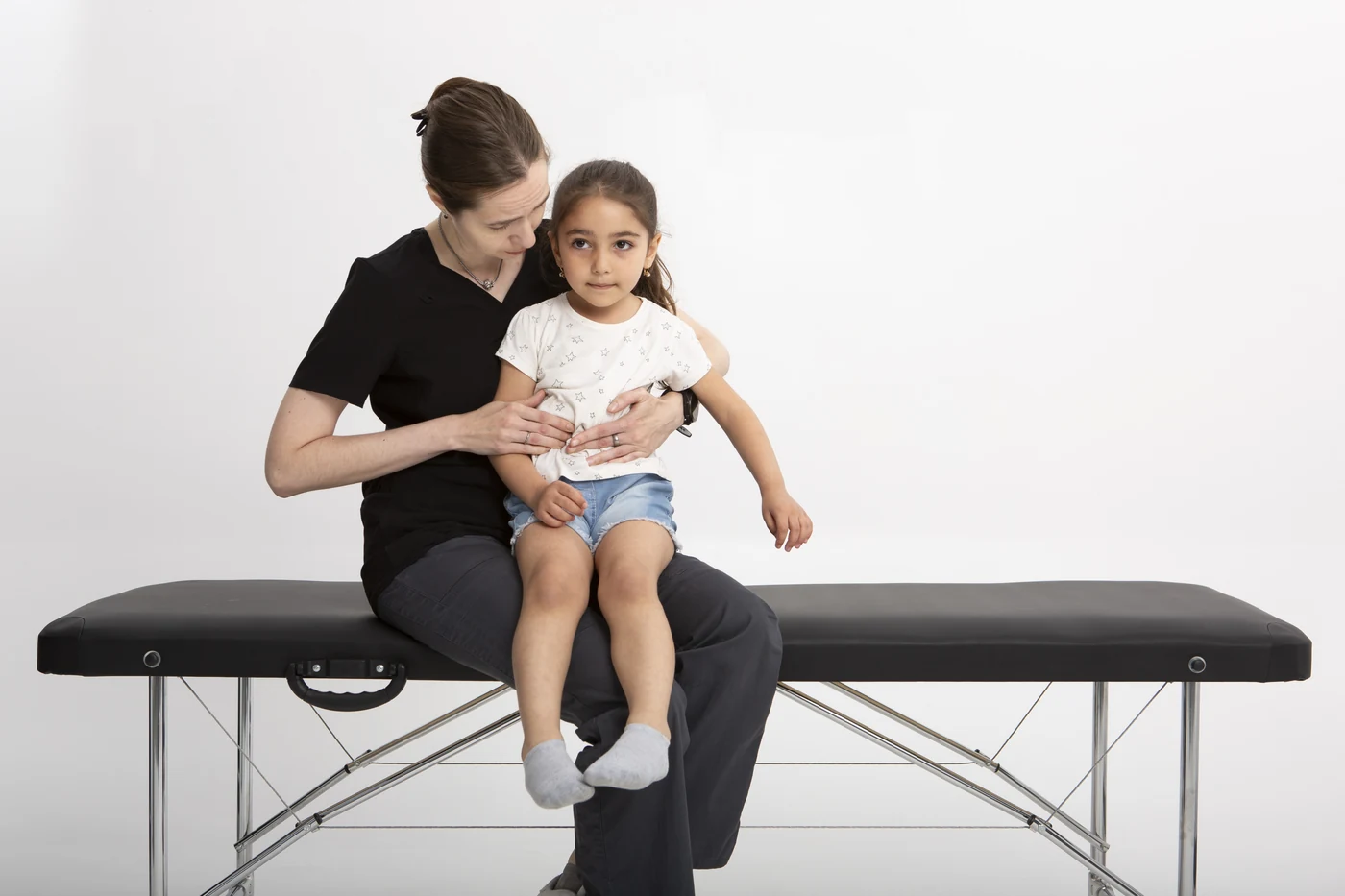
- Children from birth, including concerns about uneven head shape, restlessness, colic, digestive problems, difficulty breastfeeding, asymmetrical movement, constipation, enuresis and posture.
- Work with children with delays in cognitive and speech development, autism spectrum disorder and ADHD.
Specialisation
- Gentle osteopathic techniques without sudden movements or cracking.
- Infants from birth.
- Chronic conditions with an added emotional burden.
- Complex cases where you feel you have already tried everything.
How does a session work?
A session lasts about an hour. For babies under 6 months, treatment lasts no more than 20 minutes. The remaining time is for consultation.
At the start of the session, your practitioner will ask what is troubling you and what you have already tried. If you have sought medical advice or had scans or other tests, please bring the results.
We will ask about your lifestyle and health, including things that may seem unrelated to your concern. Osteopathy takes a broad view of your health, and the more we know, the better we can help.
We usually ask you to undress to your underwear so we can examine you and carry out tests. Tell your practitioner if you would prefer to stay dressed for any reason. We can do much of the work through clothing, although we may miss things such as a suspicious mole or a scar.
Next, your practitioner will show you a few simple movements to repeat. These tests help assess joint mobility and identify areas that need attention.
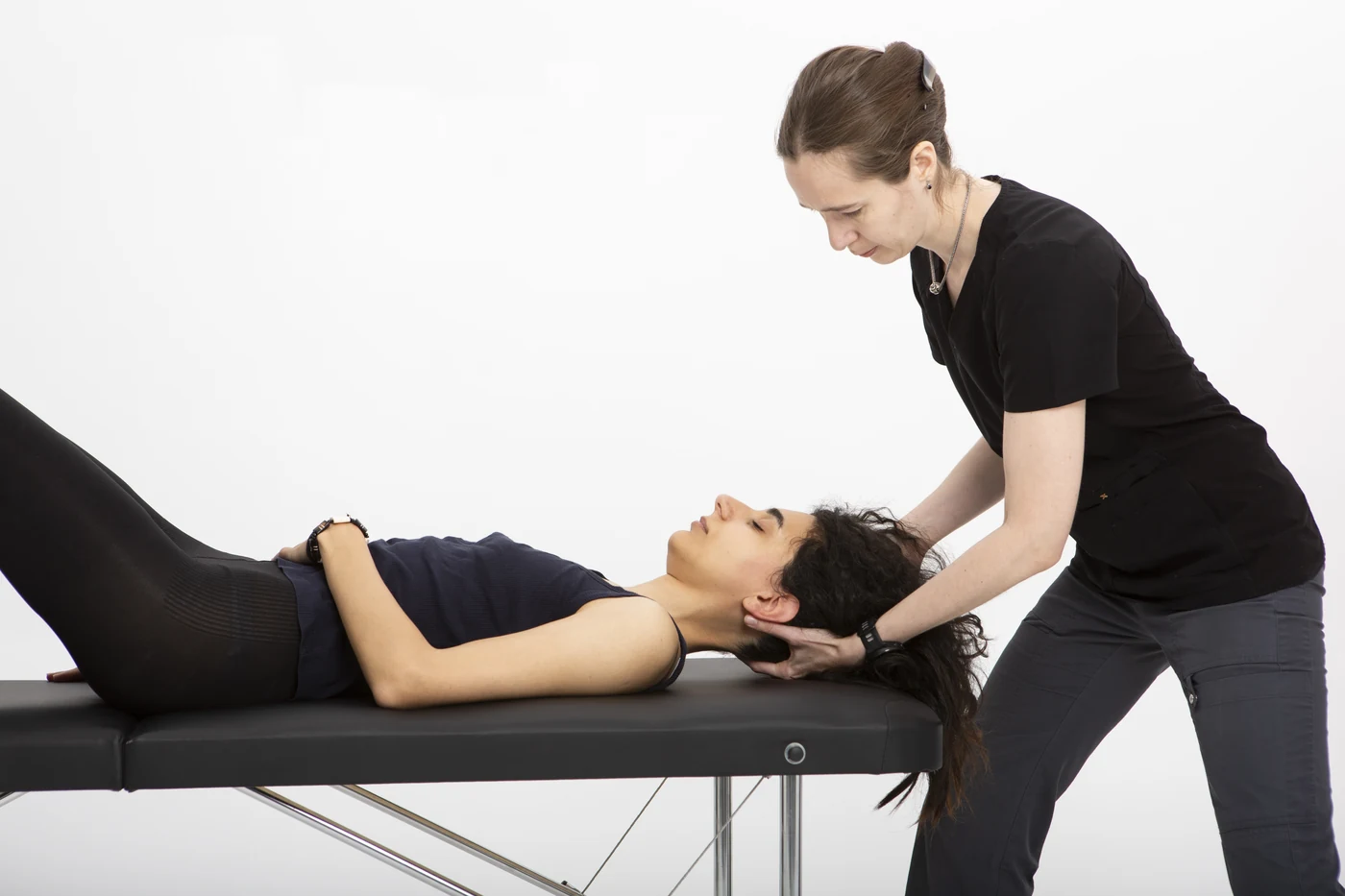
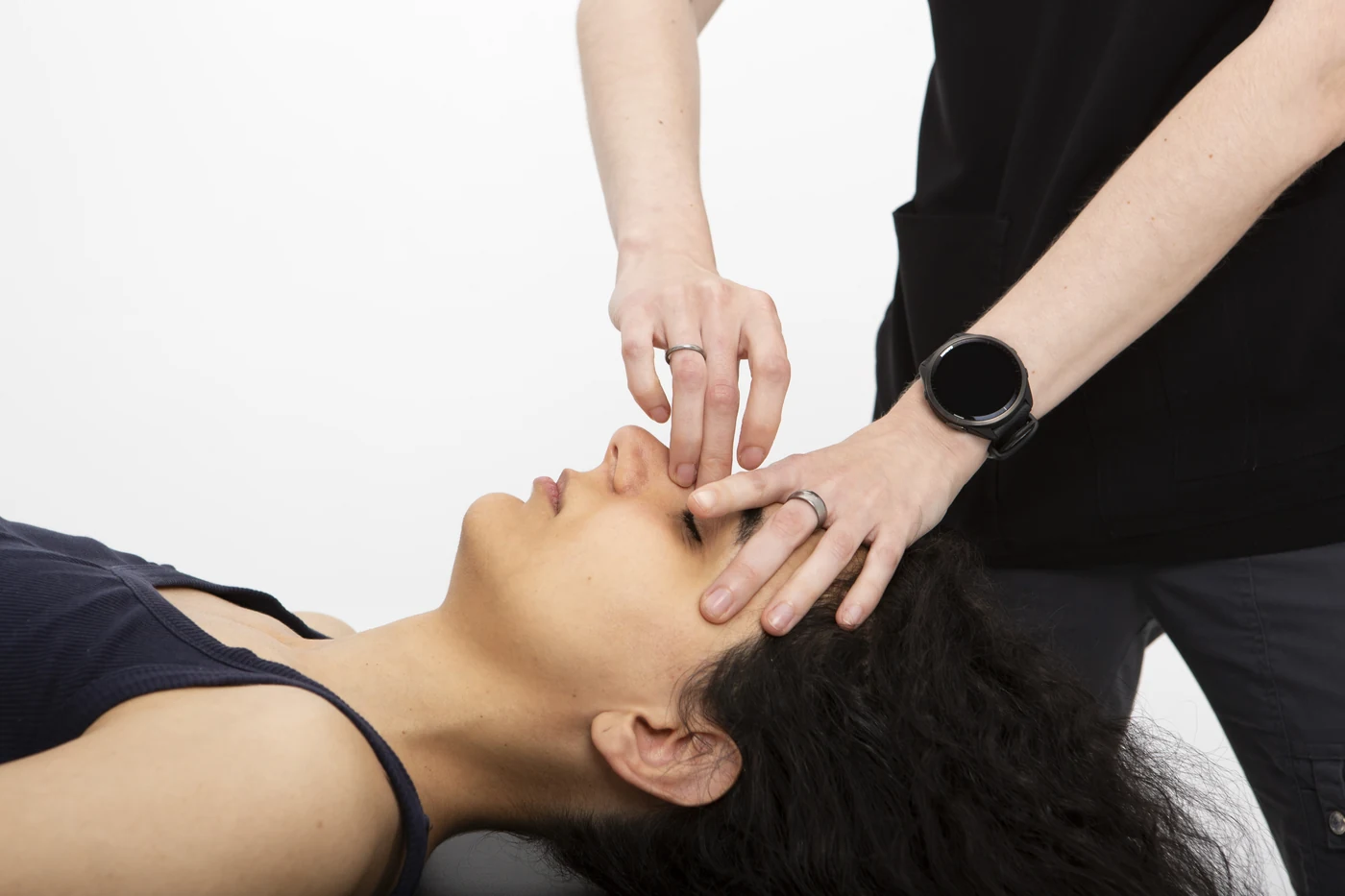
Your practitioner then uses osteopathic techniques. Tell them if something hurts, if you would prefer them to avoid a particular area, or if you would rather avoid techniques that make joints crack. We have several approaches to choose from.
At the end of the session, your practitioner will discuss the next steps in your recovery. These may include further tests, seeing another specialist, exercises, advice on ergonomics, kinesiology taping or the use of essential oils.
After the session
For about three days after the session, it is important not to overload your body. Do not move wardrobes, do a heavy workout or start difficult conversations. You may want to, as there can be a strong surge of energy. Sometimes the opposite happens and you feel very sleepy or hungry. In that case, it is better to do just that.
Pictures
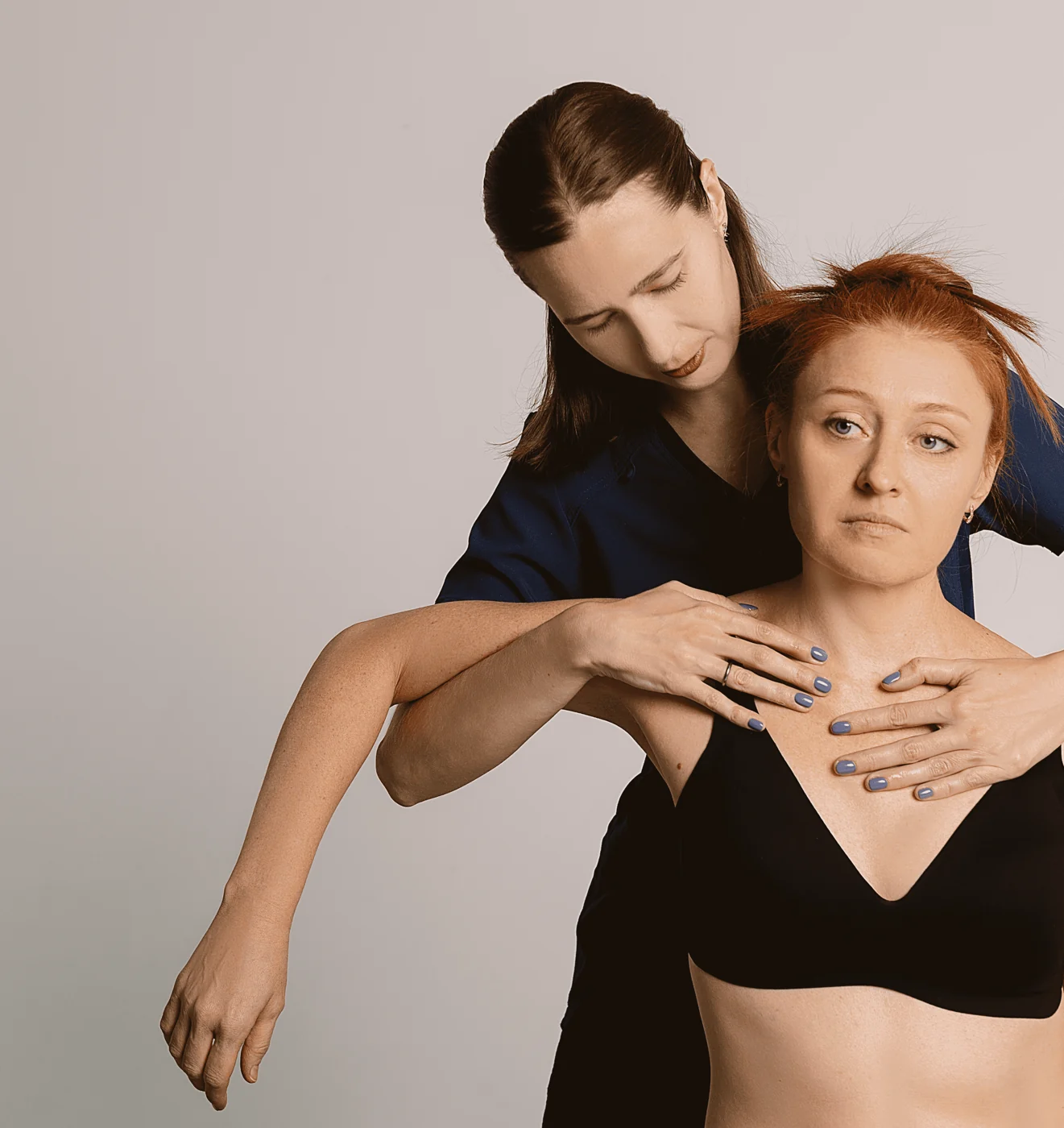
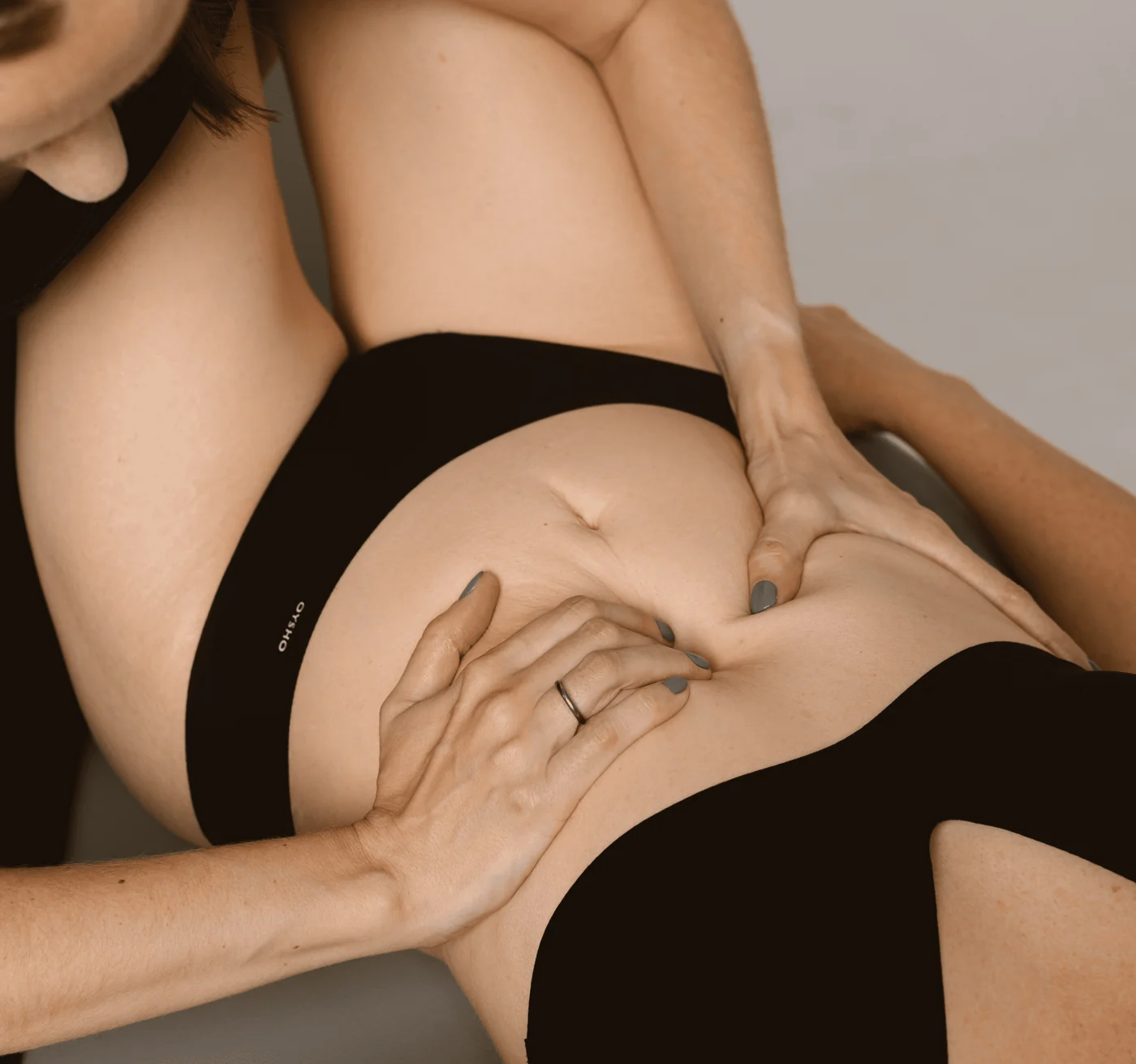
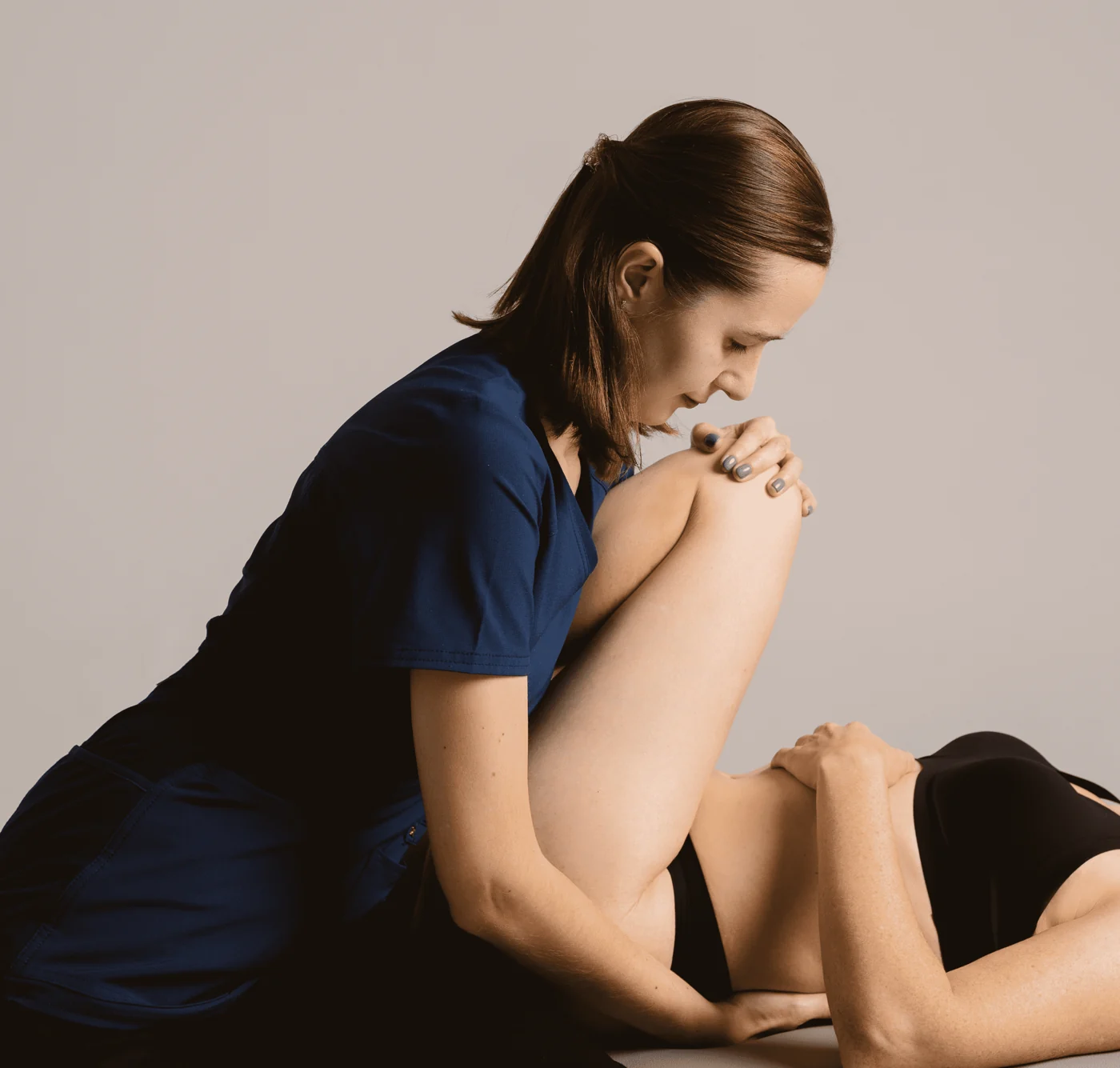
Reviews of Natalia Ermachenko
Use the arrows or swipe left and right through the reviews.
natali_bo013
Approx. April 2026
Translated from Russian
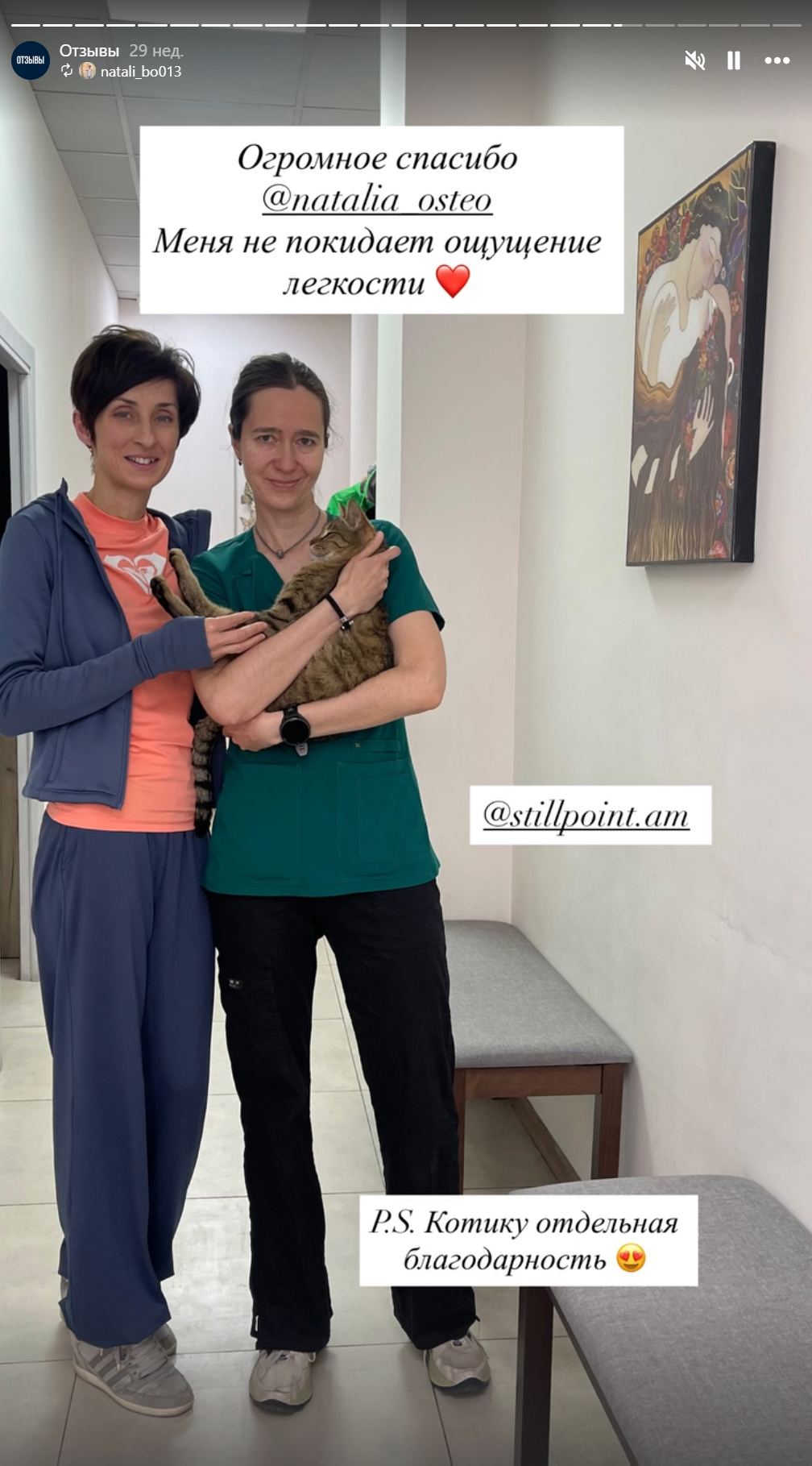
Many thanks to @natalia_osteo.
The feeling of lightness hasn’t left me ❤️
P.S. Special thanks to the cat 😍
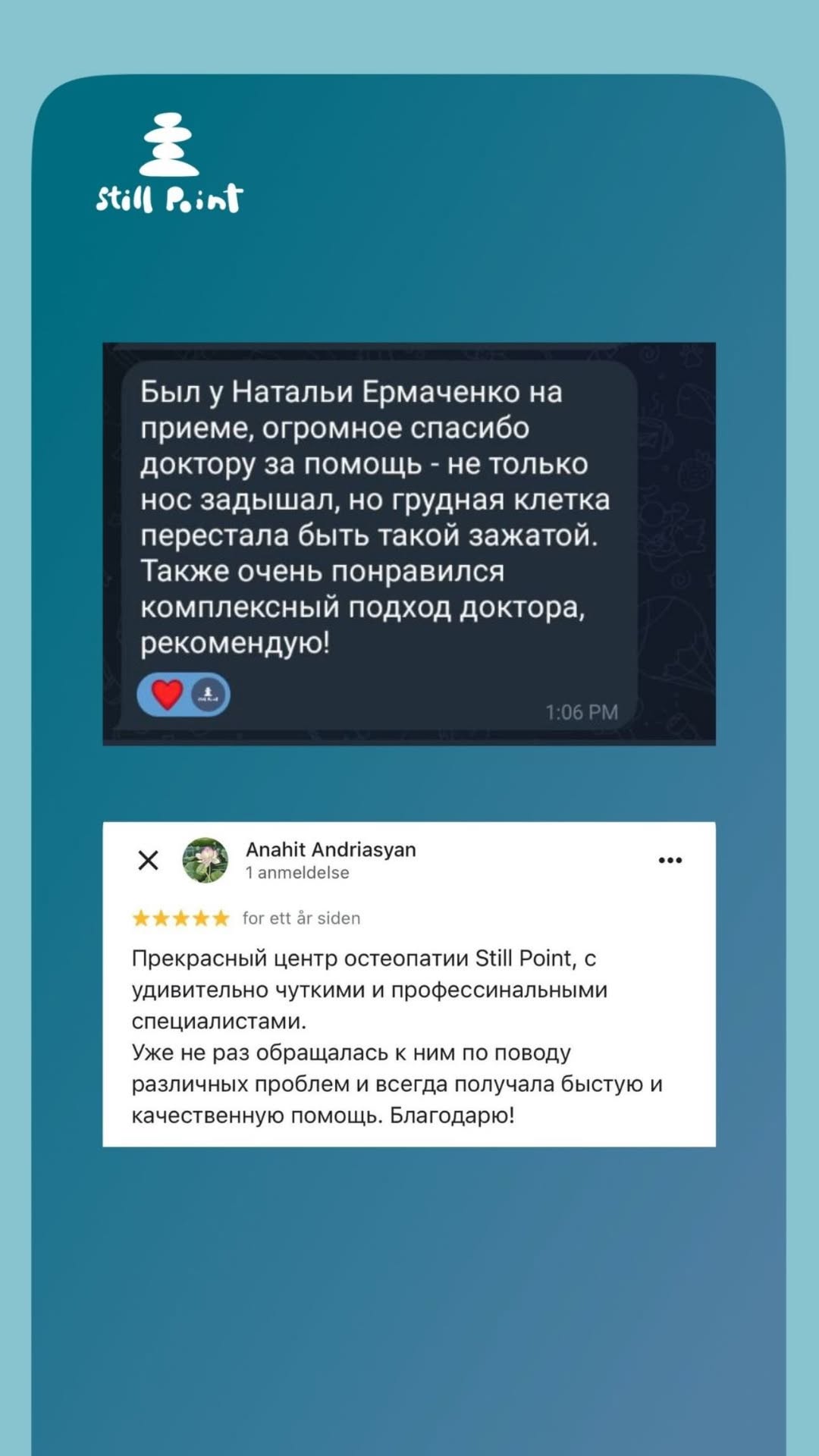
Reviewer not named
Date not shown · 1:06 PM
Translated from Russian
I had an appointment with Natalia Ermachenko. Many thanks to the doctor for her help: not only could I breathe through my nose again, but my chest also stopped feeling so tight. I also really liked the doctor’s comprehensive approach. I recommend her!
Anahit Andriasyan
Date not shown
Translated from Russian
Still Point is a wonderful osteopathy centre with remarkably attentive and professional specialists.
I have turned to them several times with different problems and have always received prompt, high-quality help. Thank you!
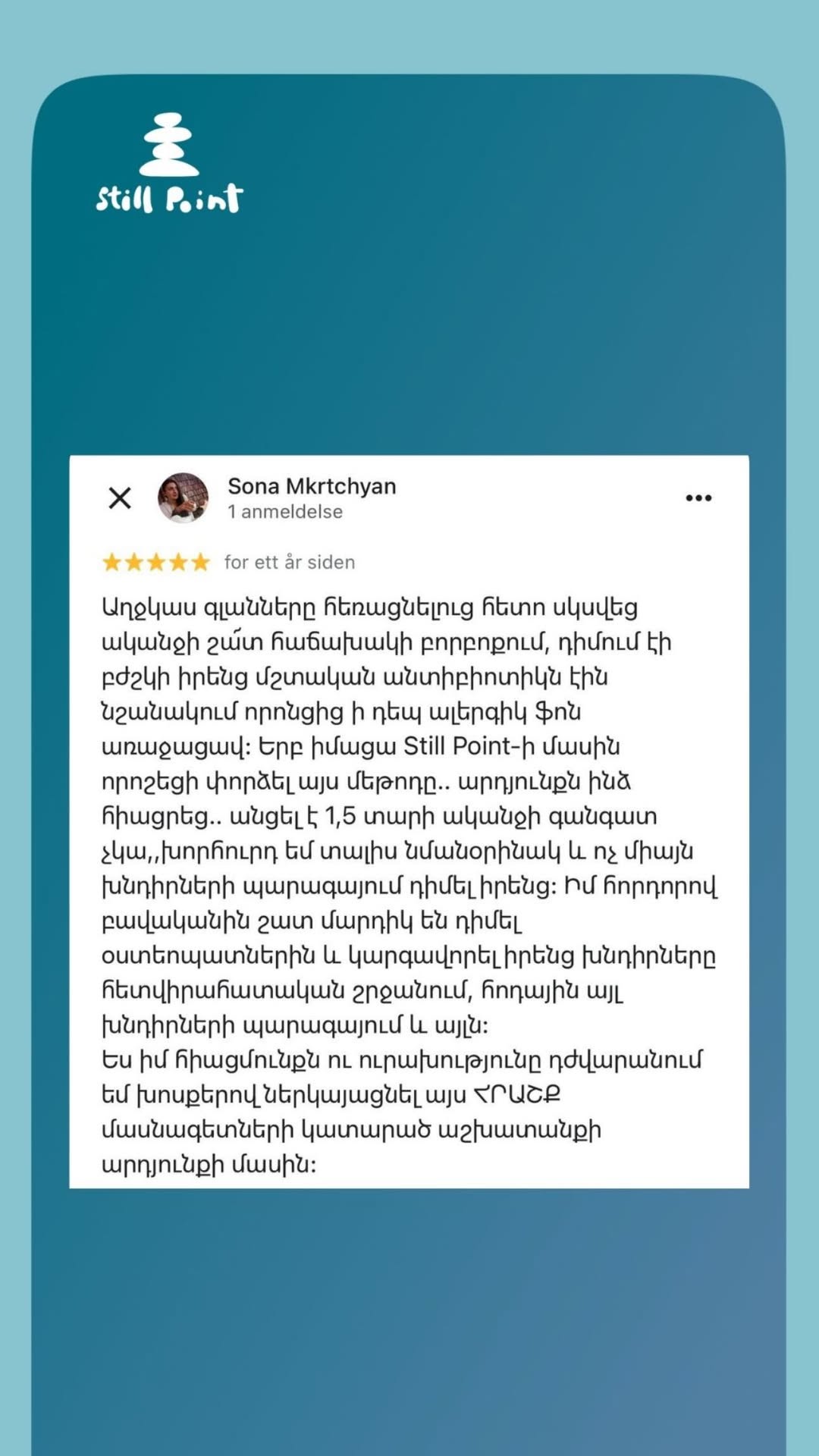
Sona Mkrtchyan
Date not shown
Translated from Armenian
After my daughter had her tonsils removed, she began getting very frequent ear infections. I would go to doctors, who kept prescribing antibiotics; incidentally, those also brought on an allergy. When I heard about Still Point, I decided to try this method. The result amazed me: a year and a half has passed without any ear complaints. I recommend contacting them for similar problems and others too. Quite a few people have consulted osteopaths on my recommendation and resolved problems after surgery, joint problems and other issues.
I find it hard to put into words my admiration and joy at the results of the work of these WONDERFUL specialists.
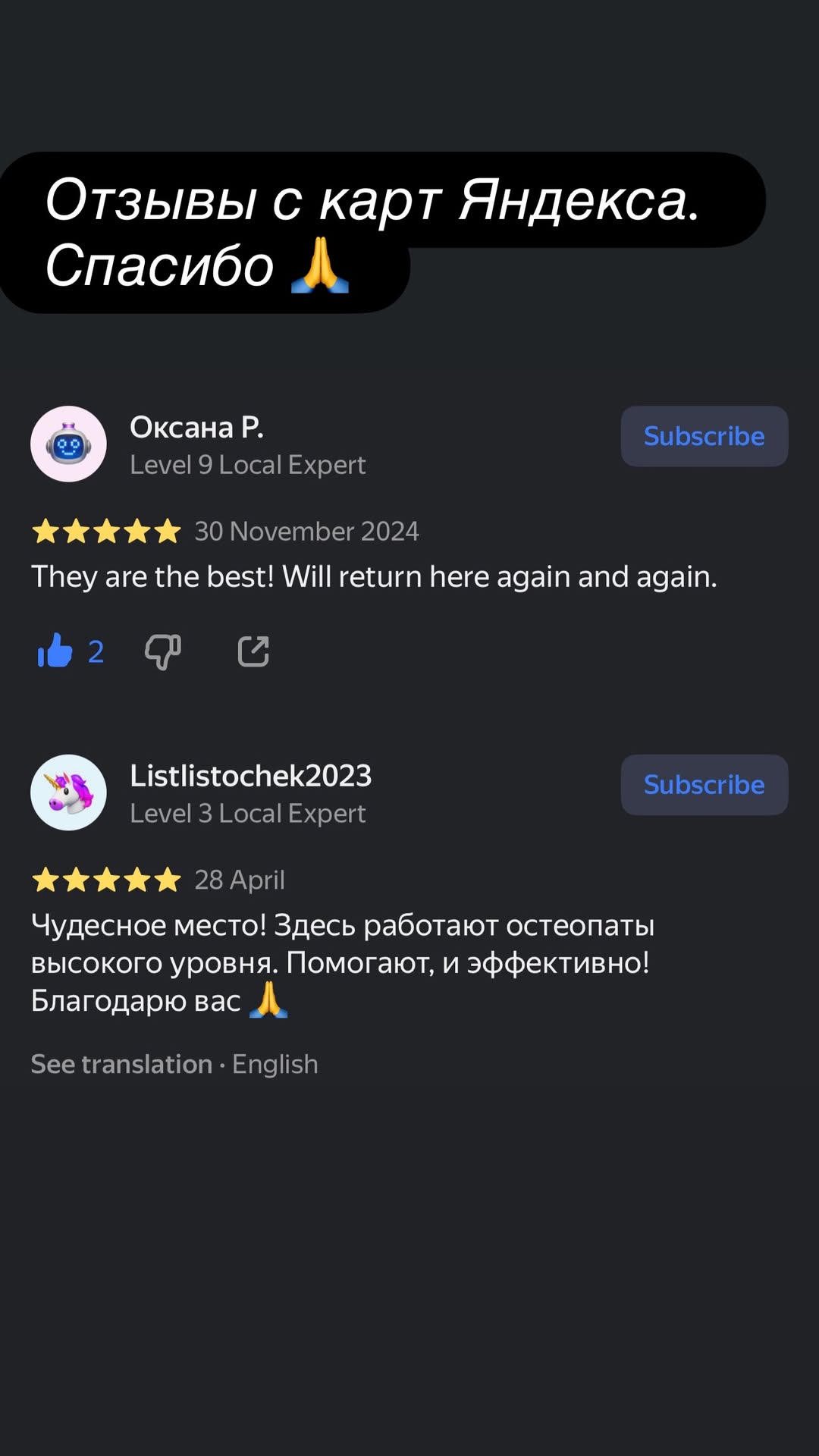
Оксана Р.
They are the best! Will return here again and again.
Listlistochek2023
28 April — year not shown
Translated from Russian
A wonderful place! The osteopaths here are highly skilled. They help, and effectively too! Thank you 🙏
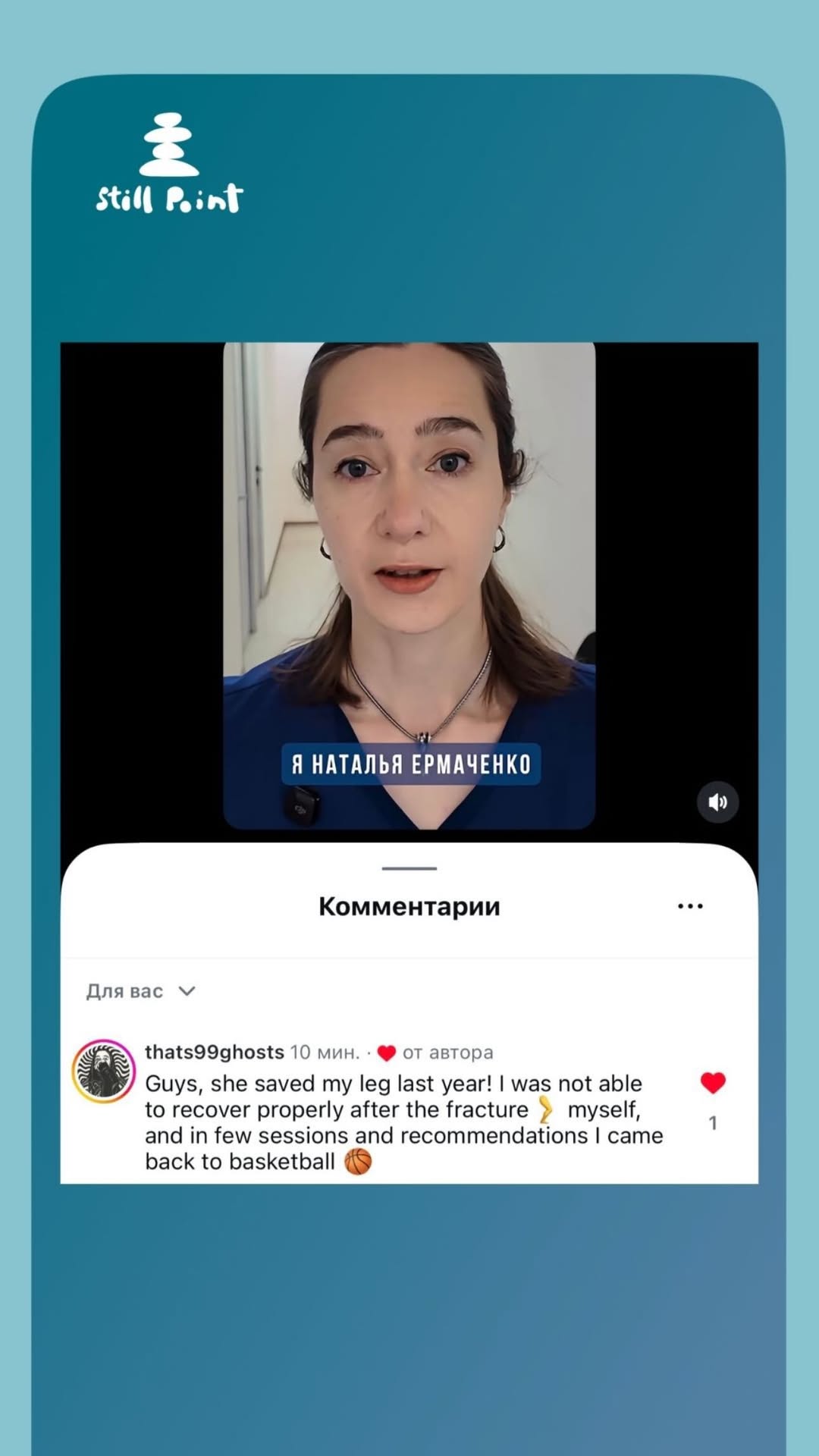
thats99ghosts
Date not shown
Guys, she saved my leg last year! I was not able to recover properly after the fracture 🦵 myself, and in few sessions and recommendations I came back to basketball 🏀
Reviewer not named
Date not shown · 10:32 PM
Translated from Russian
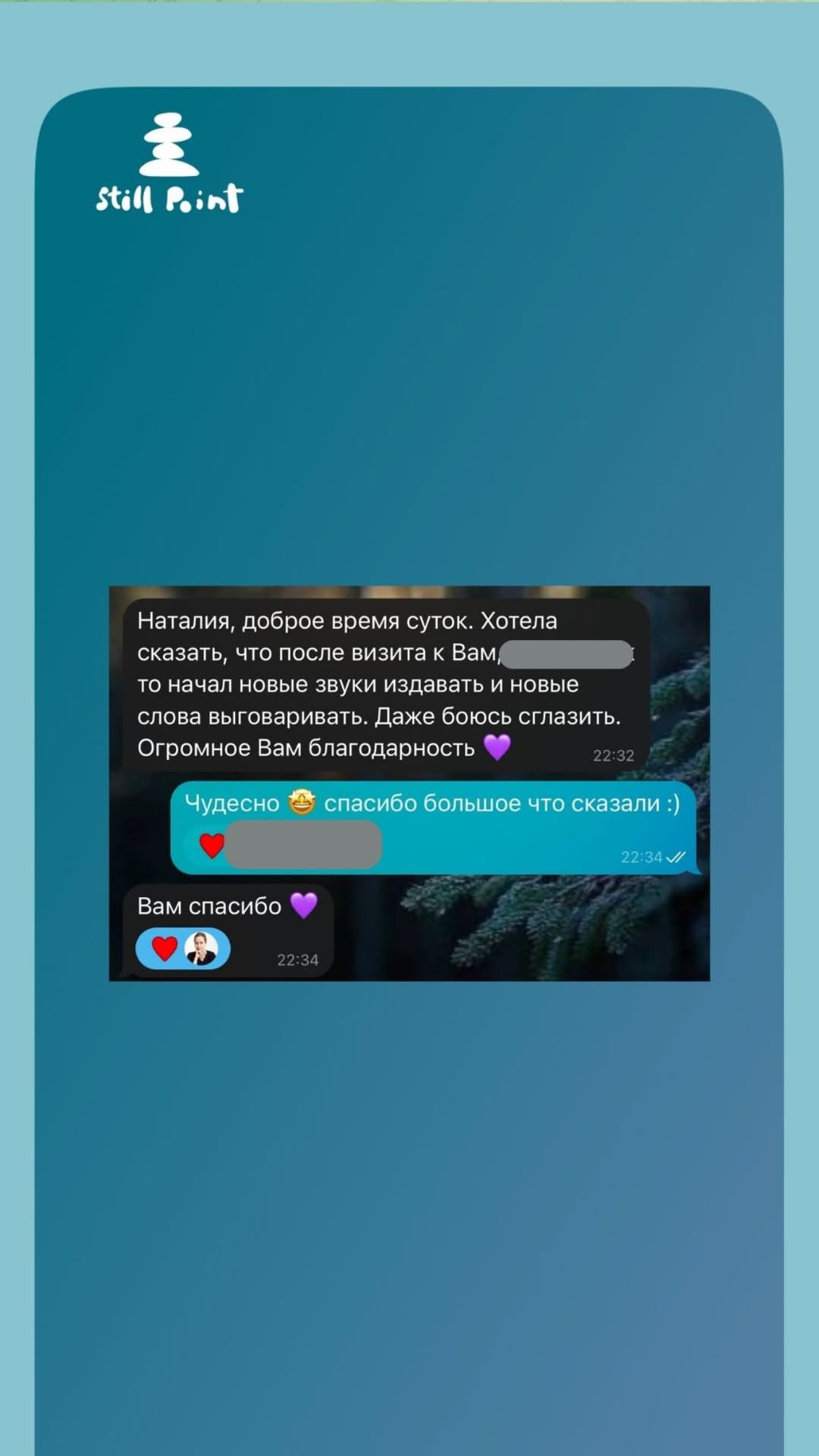
Natalia, hello. I wanted to say that after the visit to you, […] has started making new sounds and saying new words. I’m almost afraid to jinx it. Thank you so very much 💜
Reviewer not named
Date not shown · 7:49 AM
Translated from Russian
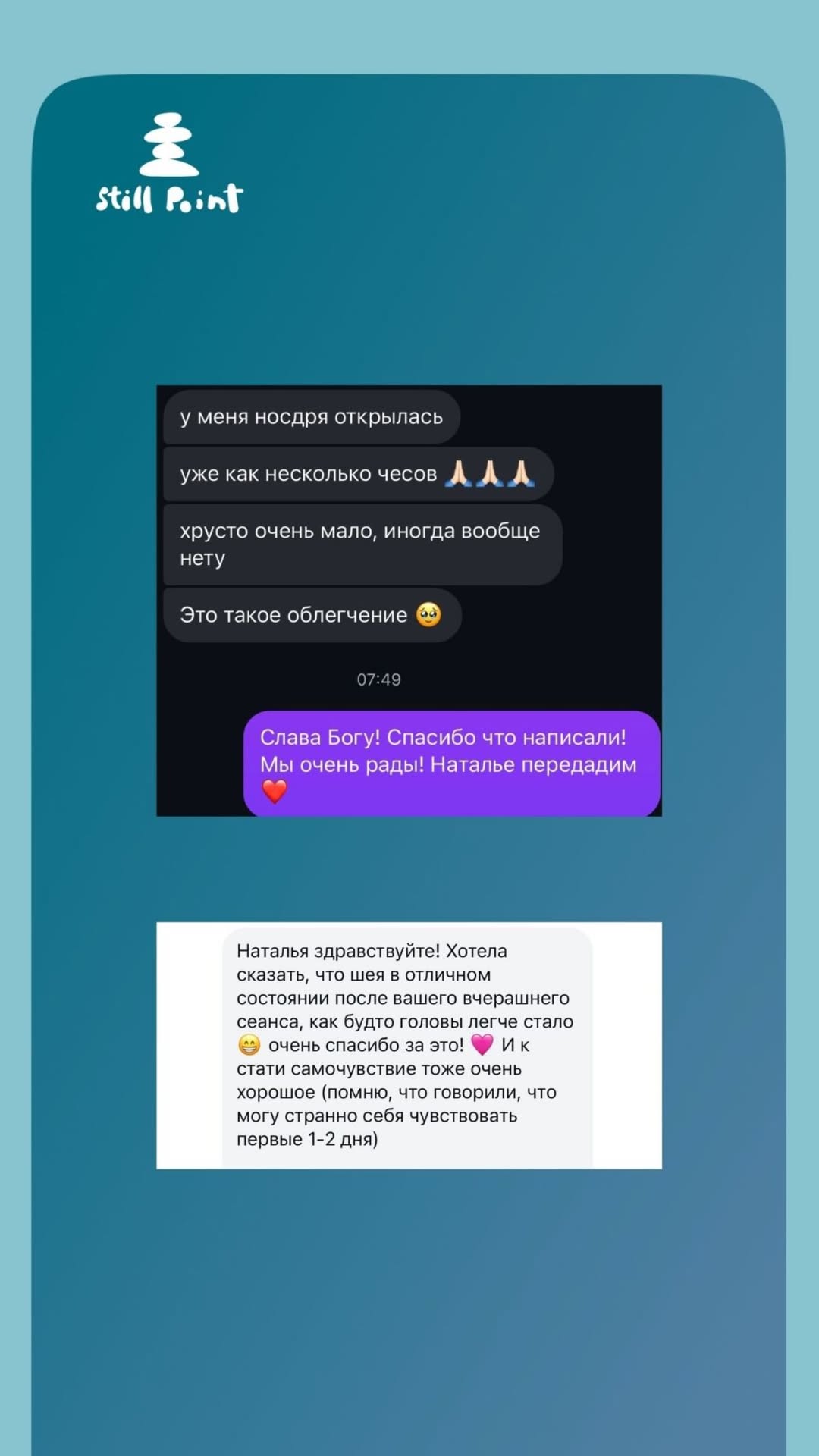
My nostril has opened up.
It’s been like that for several hours now 🙏🙏🙏
There’s very little cracking, sometimes none at all.
It’s such a relief 🥹
Reviewer not named
Date not shown
Translated from Russian
Hello, Natalia! I wanted to say that my neck feels great after yesterday’s session with you, as though my head has become lighter 😁 Thank you so much for that! 💗 And by the way, I feel very well overall too. I remember you said I might feel strange for the first day or two.
Narine Davtyan
Date not shown
Translated from Russian
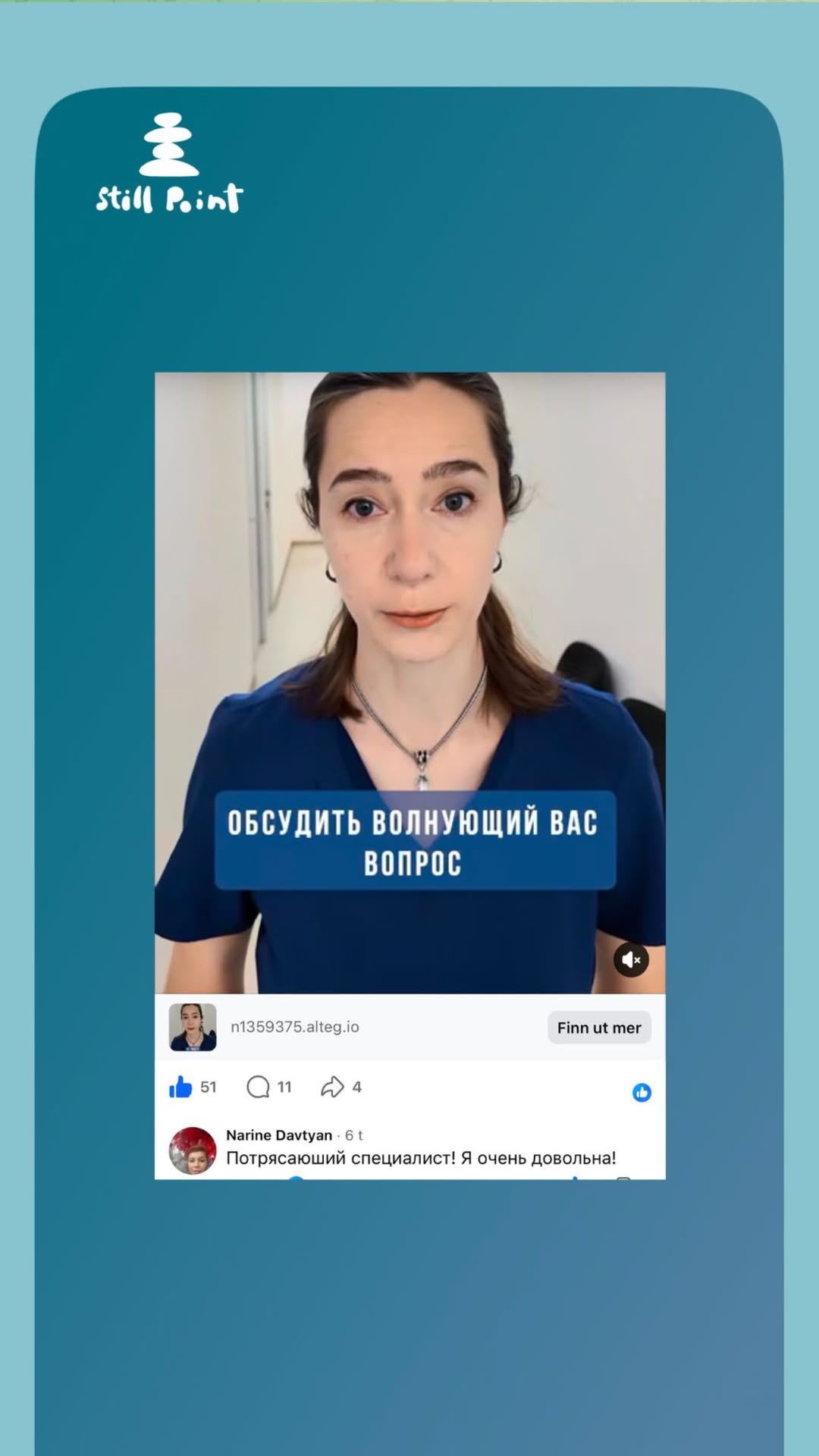
An amazing specialist! I’m very happy!
Narine Davtyan
Date not shown
Translated from Russian
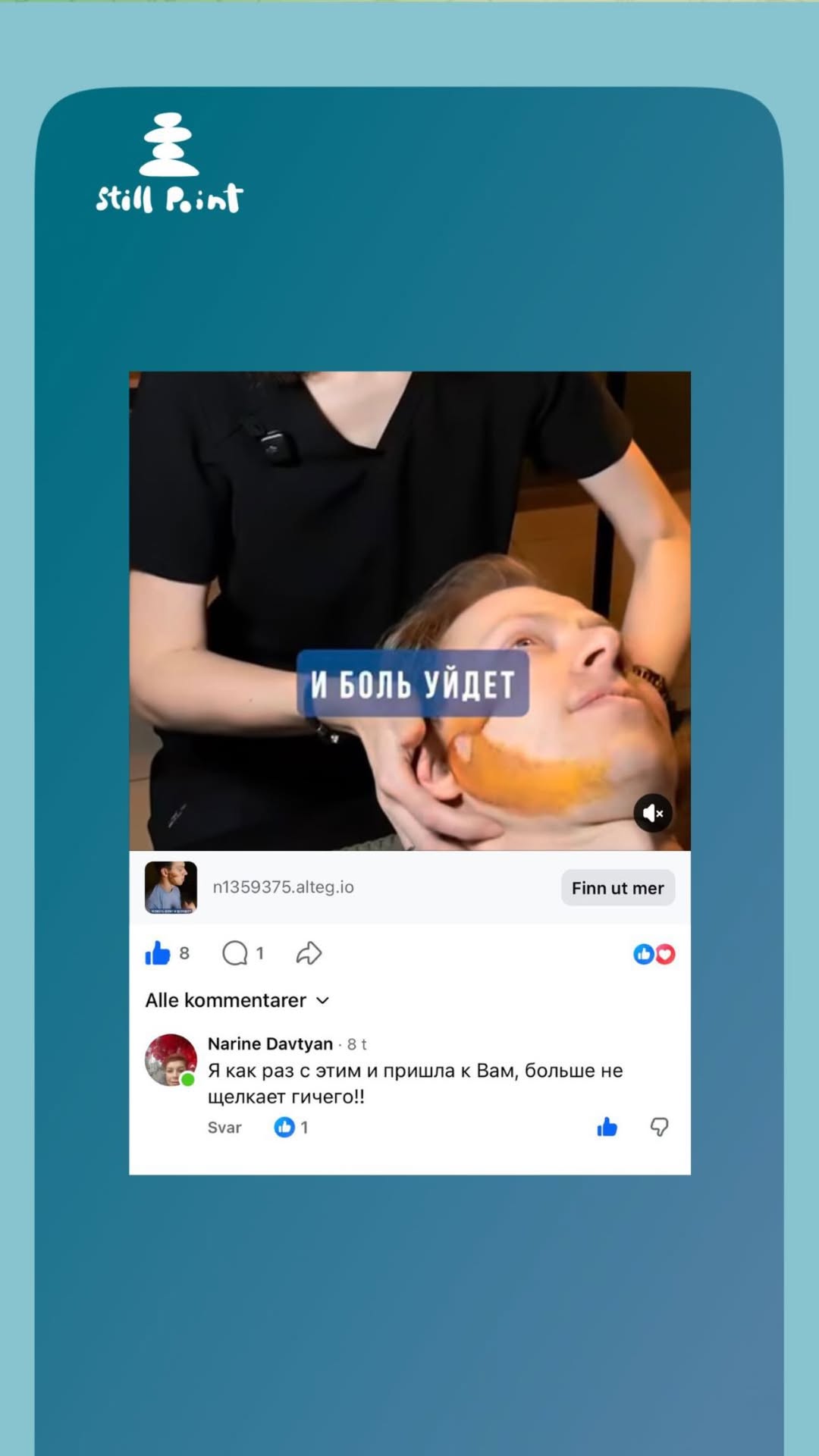
That’s exactly what I came to you about. Nothing clicks anymore!!
Reviewer not named
Date not shown
Translated from Russian
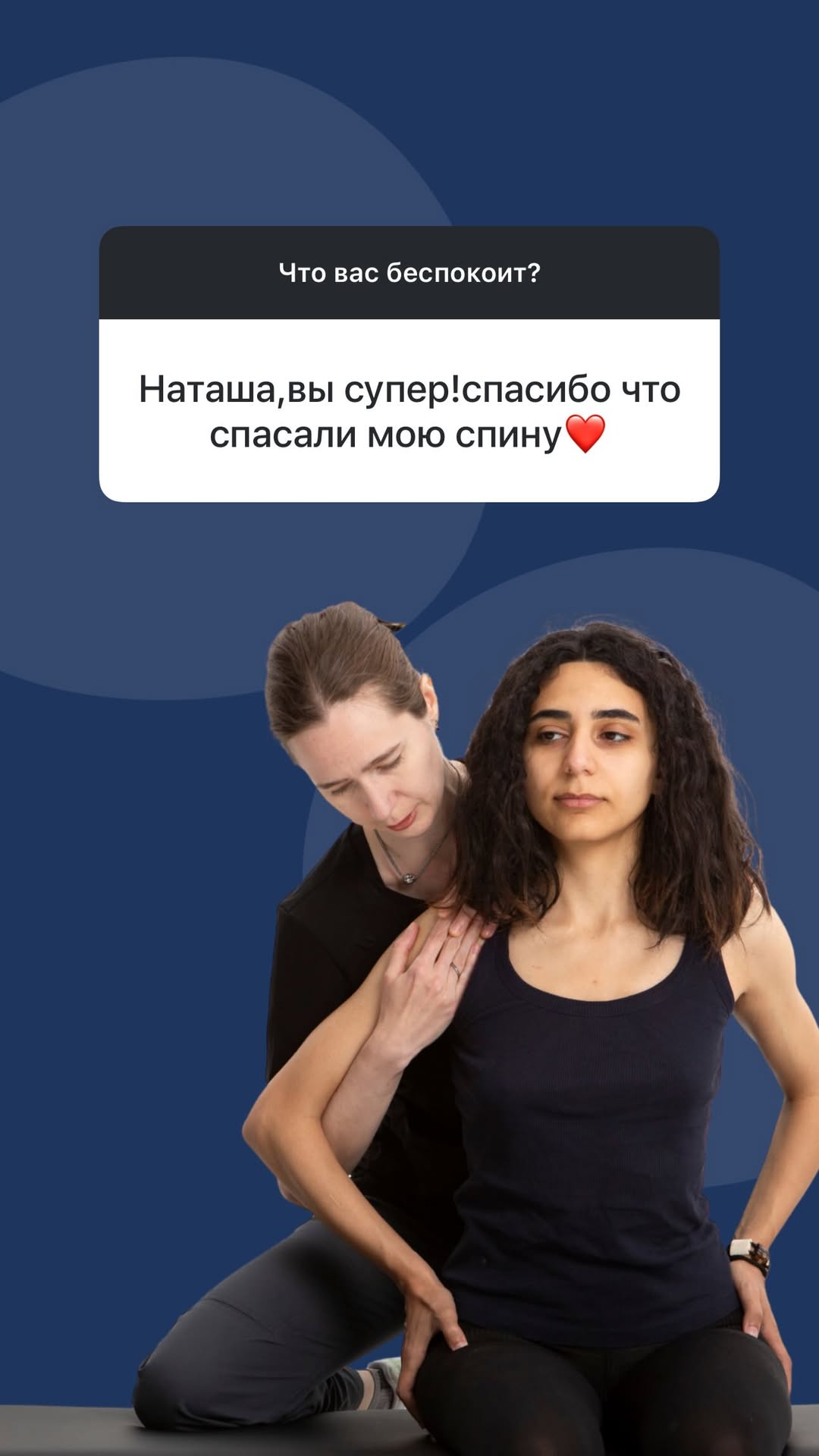
Natasha, you’re amazing! Thank you for saving my back ❤️
_encanto.am_
Date not shown
Translated from Russian
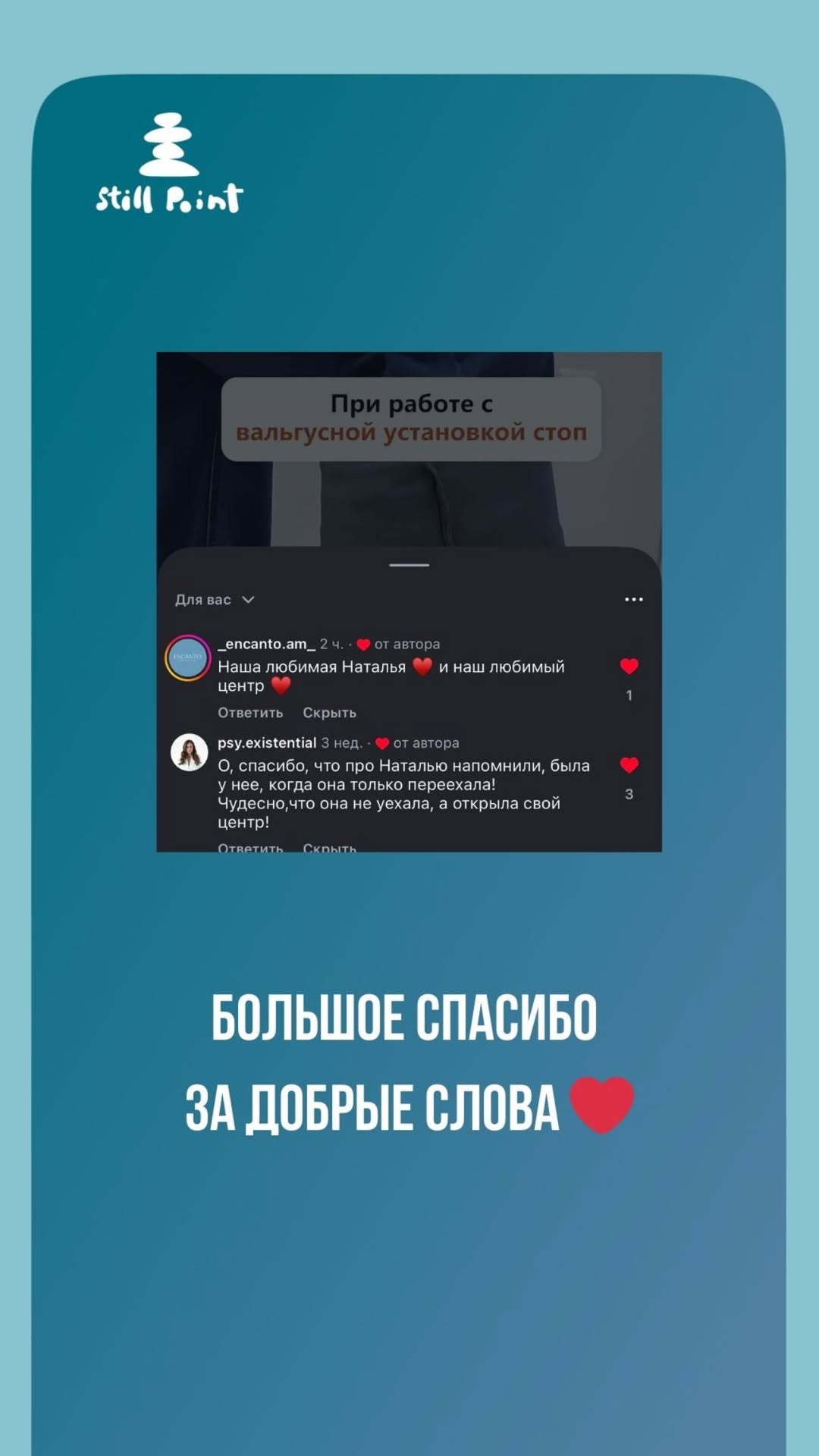
Our beloved Natalia ❤️ and our favourite centre ❤️
psy.existential
Date not shown
Translated from Russian
Oh, thank you for reminding me about Natalia! I went to her when she had only just moved here. It’s wonderful that she didn’t leave, but opened her own centre!
Reviewer not named
Date not shown
Translated from Russian
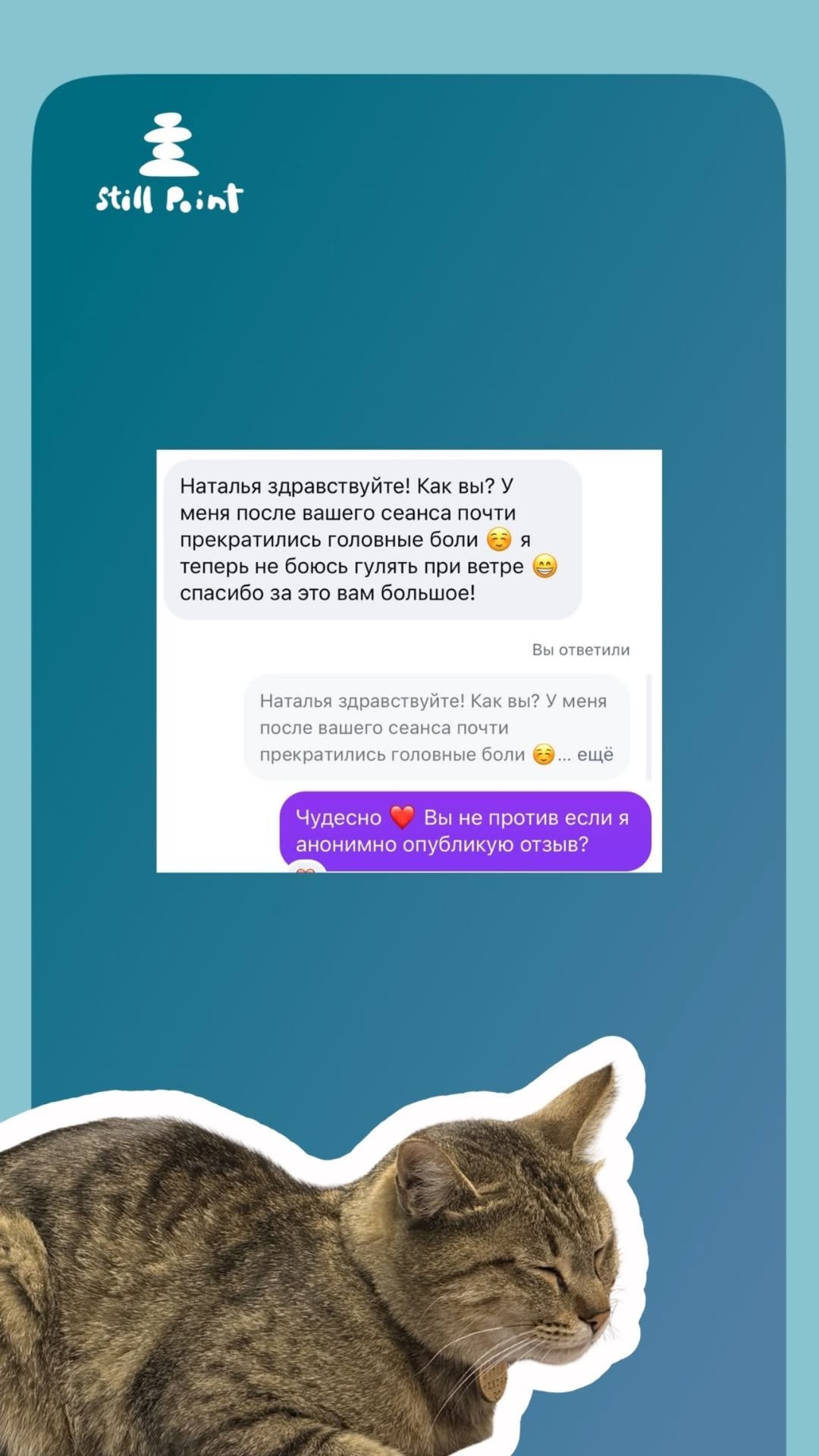
Hello, Natalia! How are you? My headaches have almost stopped since the session with you ☺️ I’m no longer afraid to go for a walk when it’s windy 😁 Thank you so much for that!
Nikk Lantsov
Translated from Russian
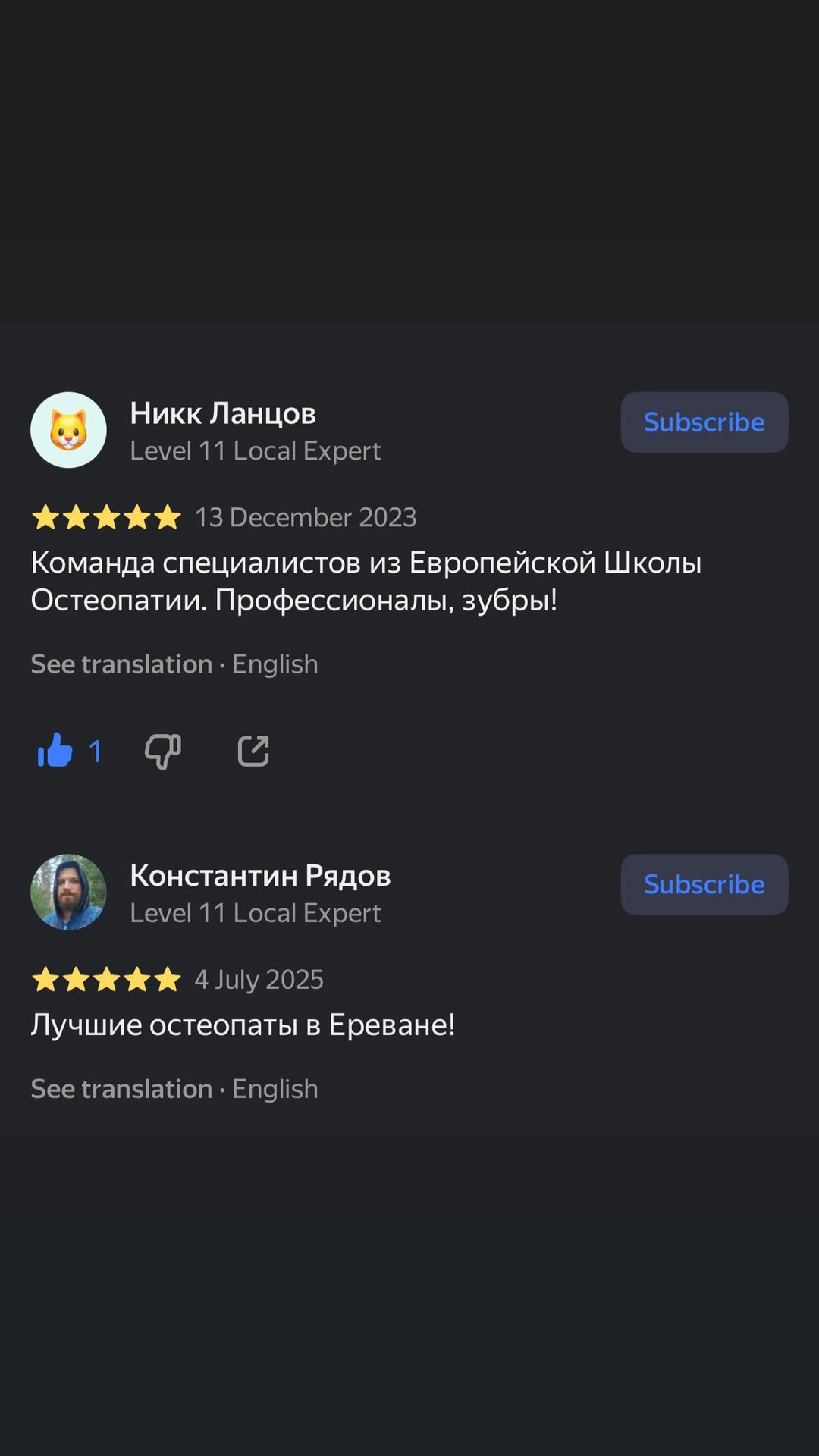
A team of specialists from the European School of Osteopathy. Professionals, real experts!
Konstantin Ryadov
Translated from Russian
The best osteopaths in Yerevan!
Reviewer not named
Translated from Russian
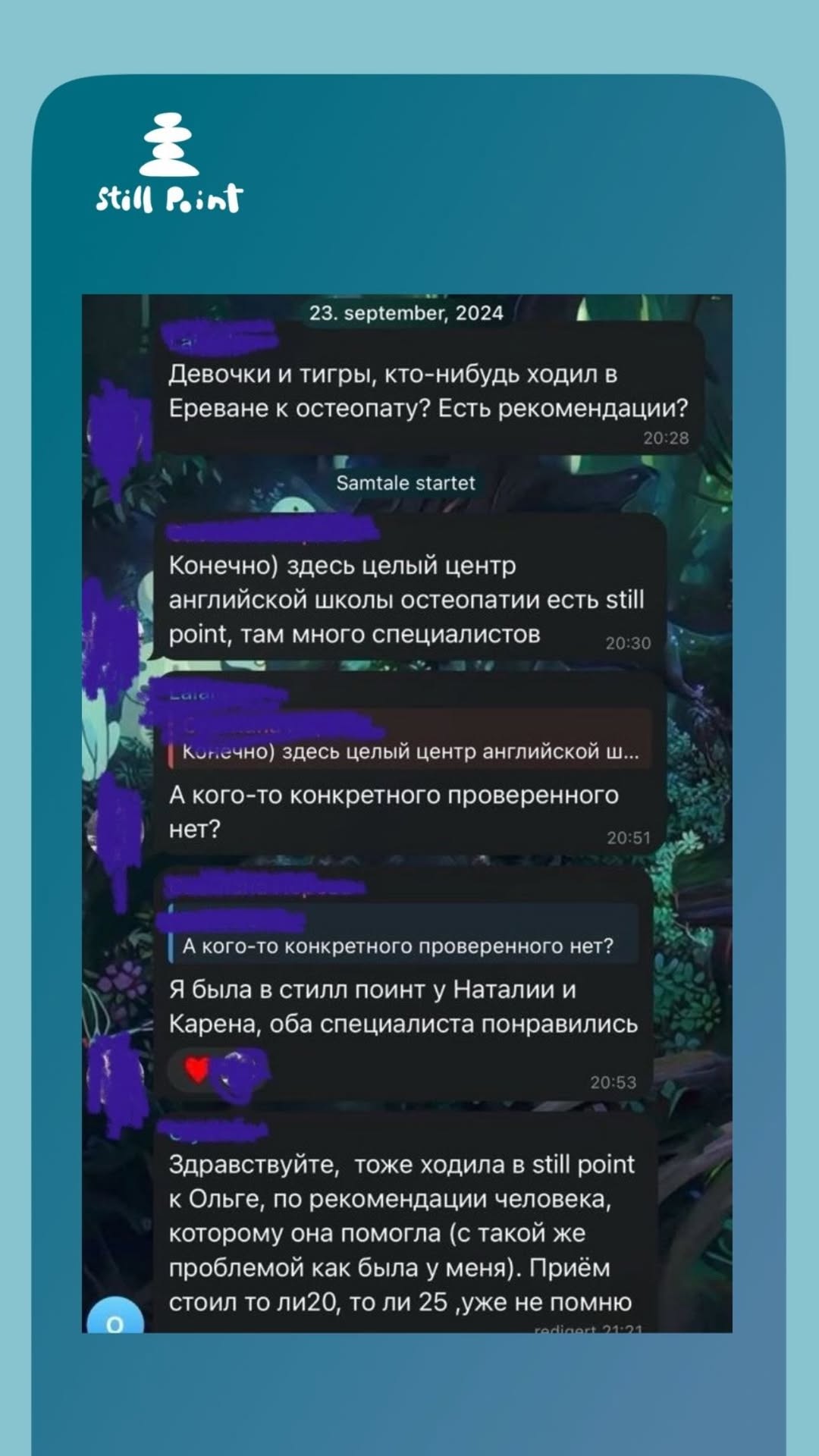
I’ve been to Natalia and Karen at Still Point, and I liked both specialists.

Roman
Translated from Russian
For about a day after the session, my body feels as if it has forgotten how to hurt, as if it has not yet slipped back into its familiar painful and uncomfortable patterns, as if it has straightened out and rebooted. Of course, it does go back afterwards, but something tells me that if I keep seeing Natalia, my body will gradually learn to live without unnecessary pain.

Elizar
Translated from Russian
I was lucky enough to win a free introductory session.
It was wonderful! Light, almost weightless touches to my head and neck, and by the time I was leaving the session, neither my back nor my neck hurt anymore. The effect lasted for several days. Several days without that constant pain I had grown used to! I think that by going regularly and fairly often, it would be quite possible to get rid of the problem completely.

Yana
Translated from Russian
For the first time in ages, my back does not hurt at all. I had forgotten that was even possible. Straight after the session, I noticed how light I felt, and not just in my back: it felt as though a very old, heavy burden had been lifted off me. I deliberately waited a few days to see how much things would change over time. Well, that feeling of lightness has stayed, and the world really does feel much easier for me than before. Thank you!

Yulia
Translated from Russian
My daughter and I are going through a course of treatment with Natalia. The situation was difficult from the start: grade 4 scoliosis, and the doctors are recommending surgery. We came to Natalia hoping for improvement and to stop the condition from progressing. It has not worsened, which is very important to us. Gradually, we are seeing improvements too. Anyone familiar with this condition will understand. I like Natalia’s approach to her work, her openness, warmth and desire to help. She always answers questions, offers advice, gives recommendations and provides support. A huge thank you to her! Stay healthy 🙂

Elza
Translated from Russian
I had treatment with Natalia Sergeyevna more than a year ago. I was having panic attacks. Anyone who knows what that is like will understand that my life felt like hell: agonising, exhausting attacks that took away my strength and desire to live. Gradually, after several sessions, everything changed and went away... I will always remember with great gratitude your small but magical hands, with such healing power) It was amazing) Thank you, Natalia Sergeyevna!

Vitaly
Translated from Russian
I work as a firefighter. Before that, I worked as a rescue worker. I had a whole collection of injuries. My knees, back and neck hurt all the time. Painkillers did not help much. I had scars on both buttocks from constant injections. I went for four sessions. Afterwards, I felt very sleepy. The pain went away straight away. What came a month later can only be described as the joy of living. I thank Natalia Ermachenko for the good she brings to people, for the relief she has given me. Six months ago, I could barely walk. Today, I was doing burpees in training. God bless Natalia with the very, very best. Thank you again and again.

Marina
Translated from Russian
Natalia, thank you so much! I came for two sessions and my husband for one. We both had back problems related to lower-back injuries. Those problems have completely resolved, and my neck feels much better too. I used to have severe pain and headaches; now there is only a little discomfort when I tilt my head back, though we will continue working on it! I really appreciated the attentive, polite manner and the calmness.

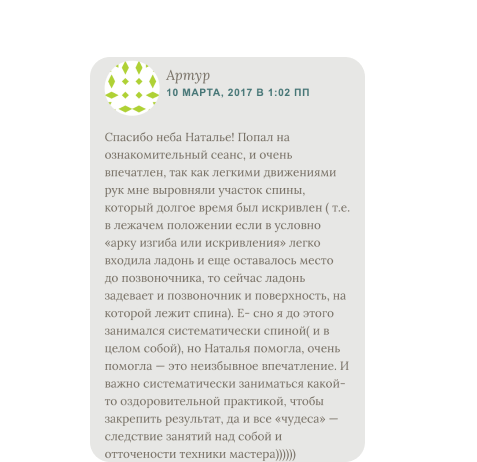
Artur
Translated from Russian
Thank you so much, Natalia! I came for an introductory session and was very impressed. With gentle movements of her hands, she straightened a part of my back that had been curved for a long time. When I was lying down, a hand could easily fit into that “arch or curve”, with room to spare before reaching my spine. Now a hand touches both my spine and the surface I am lying on. Of course, I had already been working consistently on my back and on myself in general, but Natalia helped, helped so much — it has left a lasting impression. It is important to keep up some kind of wellbeing practice to consolidate the result. All those “miracles” are the result of working on yourself and the practitioner’s finely honed skill))))))
Before your appointment
Please bring any recent clinical investigation results (ultrasound, MRI, X-rays, Doppler ultrasound, etc.).
If coming with a child, bring a bottle, a favourite toy or a cartoon on a phone or tablet.
Book online or call our manager on +374 41 252061 or message us on Telegram or WhatsApp.
The manager will explain the next available appointments and answer your questions.
Where do sessions take place?
Yerevan, 2/10 Aharonyan Street, opposite the PARMA supermarket.
Session fees
- Child session under 5
- 20,000 AMD
- First child session under 5
- 35,000 AMD
- Child session, ages 5–14
- 35,000 AMD
- Adult session
- 40,000 AMD
- Session with aromatherapy
- 50,000 AMD
Appointment languages
Russian, English, Norwegian
Any questions?
Who is osteopathy for?
Osteopathy is a versatile approach that works with all organ systems, including the musculoskeletal, nervous, cardiovascular, lymphatic, reproductive, endocrine, urinary and digestive systems. We most often see people with back, neck or joint pain or headaches, among other concerns.
Osteopathy may suit you if you:
- Have pain or discomfort that persists after a doctor found no problem.
- See a doctor, take prescribed medication and are looking for additional ways to support your recovery.
- Want a practitioner who will consider your individual circumstances and health as a whole.
- Have repeatedly been told that your concern is imaginary and want a practitioner who will take it seriously.
- Are worried about yourself or your child even though tests have found no problem.
- Try to avoid unnecessary medication and are looking for safer ways to care for your health.
- Have lost ease of movement.
- Have been through a difficult period and want to get back to normal sooner.
What concerns do you work with?
The range is broad: almost any pain — in the back, neck, head, elbow, hand, shoulder, knee or foot, or during menstruation — provided you have already been examined by your treating doctor; loss of ease of movement; low energy; recovery after a difficult period.
I have never seen an osteopath. Where do I start?
Read the information on this page and book an appointment if the method interests you.
When is osteopathy unsuitable?
Like any approach, osteopathy has its limits. In some cases it can be ineffective or unsafe. Before attending a session, check the following diagnoses and conditions:
- Acute heart attack or stroke.
- Acute injury, for example after a fall or a traffic accident if you have yet to see a doctor.
- Thrombosis.
- Bleeding. If you are menstruating or have haemorrhoids, tell your practitioner. The session can still go ahead.
- Acute infection, including fever, severe weakness, diarrhoea or vomiting. You can come for recovery support once the acute phase has passed.
- Cancer. If you are receiving treatment, check with your treating doctor in advance to confirm whether you can attend.
- Psychiatric conditions or epilepsy that are uncontrolled by medication.
- Dizziness or changes in breathing, bowel movements or urination. See a doctor first.
Osteopathy relies heavily on what the practitioner feels through touch, which is subjective. We cannot diagnose conditions or guarantee the outcome in an individual case. Fortunately, results are generally quite good.
Is osteopathy the same as manual therapy?
These are different specialties with some overlap. Osteopathy includes approaches such as:
- Visceral osteopathy (work with internal organs).
- Cranial osteopathy (work with the skull).
- Work with neurovascular bundles.
- Muscle energy techniques.
- Balanced ligamentous tension, work with fascia and other techniques.
These approaches are outside the scope of manual therapy as described here. Manual therapy focuses mainly on the musculoskeletal system, while osteopathy considers the body as a whole.
Check appointment availability online or with our manager.
All osteopaths